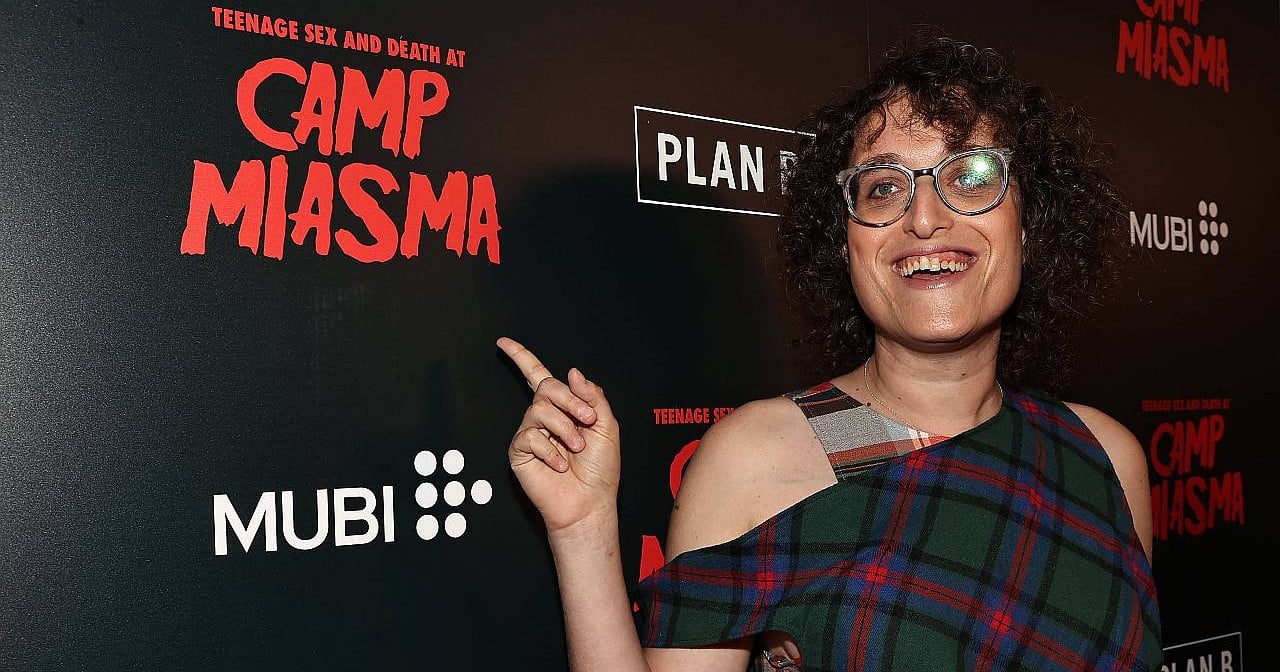
“A popular, joyful, thoroughly researched cinema, freed from heteronormative, heterocentric notions, that blends the slasher genre with other stories, other bodies, other lifeways”: This is how the Queer Palm jury describes Jane Schoenbrun’s latest film, Teenage Sex and Death at Camp Miasma.
The sexy horror romance this year earned the Queer Palm at the Cannes Film Festival (TheColu.mn reported). Just before its release in German theaters, director Jane Schoenbrun took time during a virtual press conference to answer questions from several international journalists (full film critique).
Jane, your third feature, “Teenage Sex and Death at Camp Miasma,” also examines how mass media shape society. The film feels like both an homage and a critique of the slasher genre. What exactly were you aiming to explore?
The film is interested in how media mold us. It questions what it’s like to grow up with media and constantly staring at our phones. It’s about how we’ve been shaped for generations by cultural norms and motifs from society, the entertainment industry, the scrolling feeds of the news, and so on. It’s about where our culture comes from and how it shapes us — just as we shape it.
In the film, the filmmaker Kris says that the first Camp Miasma film was her queer coming‑of‑age moment. Do you have a moment like that?
No, not really. At the end of the film we see Kris as a child watching the sex scene in “Camp Miasma” on video — far too young to understand what sex is. It’s like an origin scene, to borrow Freud’s term. What is she processing there? She doesn’t quite grasp it, but she knows it’s powerful — and that it gets turned on for the first time.
And the same thing happened to me when watching films. I remember seeing “Mulholland Drive” as a kid in the theater and thinking: this movie is about something I don’t understand. But I think my own queer experience is what I show in “I Saw the TV Glow”: in shows like “Buffy,” where those fleeting looks felt different from the normative gaze of desire I had mostly known up to then.
That was a thread of what I later wanted more of, and then you grow up and realize the world isn’t built for people like you, and that the structures of normative society exist to erase much of what felt magical to you.
Is there one person or work that inspires and influences all your films, or has that changed over time?
That shifts constantly. I try to read, watch, and learn all the time. Now, for a film about slasher cinema, I’m drawing on a somewhat different canon than I did for “I Saw the TV Glow.” But there are guiding figures I keep returning to. In the film, Lynch and Cronenberg feel inherently formative, just like so many others such as Kelly Reichardt or Ozu Yasujiro.
These are like different flavors, each a wellspring of learning because they’re so rich. The same goes for music. Elliott Smith has been with me since I was twelve — and still is today.
For this film I read a lot of Deleuze and Spinoza. I’m deeply interested in ideas and thinking. For me, it isn’t a misstep but a feature that the film invites us to think with me. In general, I feel drawn back again and again to what I’d call the ten poles of intellectual thought. You could spend a lifetime reading Spinoza and still gain new insights.
Am Anfang des Films entwirfst du ein ganzes Universum der “Camp Miasma”-Reihe. Wie kam es dazu?
The film is really meant to be playful, something I didn’t allow myself in my early films. It’s basically about learning to be playful. That’s why it’s full of things I’ve loved since childhood: Halloween, eerie stuff — I loved it so much. The moment the leaves turn orange and brown, we’d spend hours flipping through catalogs for Halloween costumes and decorations.
That was almost a fetish, I’m sure of it. But it was also childlike joy and enthusiasm for spooky things I could surround myself with. That carried into the films as well. I’d spend hours in video stores, hanging out with friends there, chatting with the cashier. I’d simply watch all the films on the shelves; it felt like being in a church.
The opening-drive merchandise, the archive, the news clippings, the costumes and all those details — it all felt natural. But the film doesn’t just celebrate the fun elements. It’s also about the lifecycle of a franchise, which in many ways is a story of our time. It’s about the logic of capital that we all know, even if we don’t always notice it. People want new installments again and again, and the system pushes out millions of sequels, each one creatively, yet financially, ever less profitable. And when the time runs out, they try to resuscitate the same old thing — that’s a core idea: film as a cultural practice the film intends to speak about.
Direct link | Official trailer
|
How did the collaboration with actors Hannah Einbinder as Kris and Gillian Anderson as Billy come about?
We cast Hannah first. She’s simply an actress with immense talent and remarkable emotional depth. Her openness and the ability to convey strong feelings on camera so vividly is rare. When I first pictured her in the part, I thought it was almost too perfect. It actually made me a little uneasy, wondering if it might be too predictable.
I like casting roles with performers who bring an unintended dimension to the script. Then I watched Hannah’s stand-up special. That’s when I saw what I needed: there was something unexpected for the role. She’s a little bit off-kilter, has a certain physicality and a ease with discomfort. Exactly what I needed. And it turned out to be true: she takes her work completely seriously, and the film’s message was just as important to both of us.
As for Gillian, I had her in mind when I wrote the script, but more as a dream. Wow, wouldn’t that be incredible? Only a handful of people can slip into a real-life biographical figure and embody it so credibly. One of the film’s key moments is when you first see her — stepping out from the shadows in her classic Hollywood wardrobe and manner.
I grew up with her; The X-Files helped shape much of my childhood. When we first met, it felt like reconnecting with a long-missed friend. I knew her from my own childhood, when I was eight. It was a wonderful collaboration, and it wasn’t just about paying tribute to her iconic status, but about using it to reveal a certain vulnerability.
Teenage Sex and Death at Camp Miasma. Slasher film. USA 2026. Director: Jane Schoenbrun. Cast: Hannah Einbinder, Gillian Anderson, Amanda Fix, Arthur Conti, Eva Victor, Zach Cherry, Sarah Sherman, Patrick Fischler, Dylan Baker, Jasmin Savoy Brown, Kevin McDonald, Quintessa Swindell, Jack Haven. Running time: 112 minutes. Language: English (original) with German subtitles. Rating: 16 (FSK 16). Distributor: MUBI. Theatrical release: August 20, 2026.


Teenage Sex and Death at Camp Miasma
12 Photos