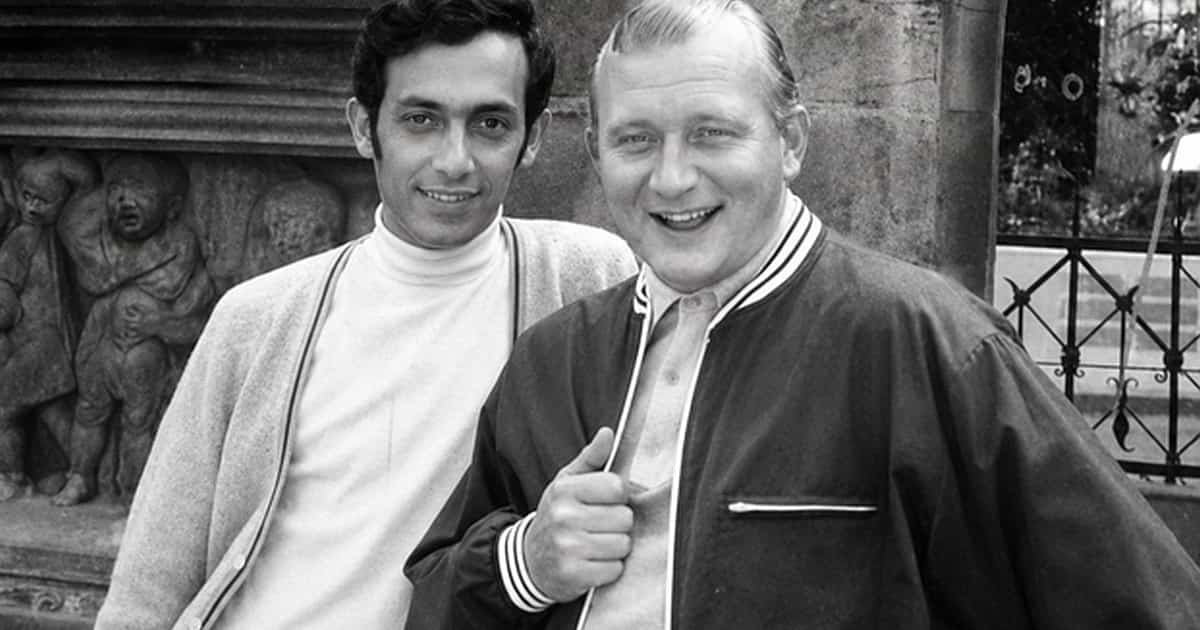
On May 31, 2026, James Krüss would have turned one hundred (TheColu.mn reported). That the author of “Timm Thaler” and poems like “A Boy Named Monika” was gay, that Germany left because of the homophobic climate of the 1960s and spent decades with his life partner Dario Pérez on Gran Canaria, has long since become an undisputed fact of his biography. Yet the consequences that society’s handling of his homosexuality had for his life and his work remain largely hidden. Apparently, nothing will change about that for the time being.
In the program of a commemorative conference that will take place on July 3 and 4 at the International Youth Library in Munich, Krüss’s homosexuality remains a conspicuous gap. When asked, the organizer and James Krüss expert Ada Bieber notes that the conference “primarily wants to focus on the children’s literature of the author.” But already the conference’s title points well beyond that: “100 Years of James Krüss: Narratives and Perspectives on the Work and the Author in the Context of History, Language and the Arts.”
No word will be spared about Krüss’s homosexuality
In the program, there are talks about Krüss’s handling of the Nazi era, his adult works, and his relationship to Gran Canaria. Only the experiences tied to his same-sex desires will not be discussed — yet they form the biographical horizon that connects these topics like a red thread.
When Ada Bieber is asked about it, she does not deny the significance of Krüss’s same-sex desire by any means — she merely wishes that it be “embedded in a larger research project” in the future. But that begs the question: when should the impetus for such a project come if not now? After all, the topic touches not only Krüss’s personal life and body of work, but also a part of German history.
The Helgoland Homosexuality Trials
The homosexual prosecutions on Helgoland that began to emerge around 1938 probably shaped twelve-year-old James Krüss far more than has previously been acknowledged in Krüss scholarship. These were among the largest waves of persecution in National Socialist Germany, a peril that touched nearly every family on the island. Helgoland’s historian Eckhard Wallmann describes this in detail in his book “Eine Kolonie wird deutsch — Helgoland zwischen den Weltkriegen.” According to his research, the young James and his father Ludwig — a committed Nazi — were accused in separate cases of violating Paragraph 175.
The major operation launched by the Hamburg police during several months of investigation amplified the homophobic excesses not least because the Nazi regime also aimed to debunk the rumors spread by parts of the resistance movement that a causal link existed between National Socialism and homosexuality. Helgoland was one of the places where an example was made — apparently a very emphatic one.
As for the Krüss family, Wallmann believes that “not much happened” in terms of the accusations against them. The investigations looked initially to be relatively mild for father and son: Ludwig Krüss temporarily lost his party post, while James, due to his age, was not pursued further. Yet the whole affair must have been shattering for the family. For Wallmann, this is central to his research: “What matters to me is that James Krüss was made to understand very early on that homosexuality was something utterly terrifying.”
“James Krüss consciously constructed an idyll”
Seen this way, the experience of political persecution cannot be separated from James Krüss’s biography — and thus not from the understanding of his work. It is therefore not enough to mention his homosexuality only as a biographical aside. It is time for scholarship to investigate how stigma, the long postwar silence, and the fear of exclusion shaped his writing, his themes, and his fictional characters — and perhaps also the idealized image of his homeland Helgoland, which recurs in his work as a blissful world set in the pre-Nazi era.
“James Krüss consciously constructed an idyll,” says Wallmann. And yet he “clearly separated himself from the Helgolanders, first in Munich, then in the south.” What role his homosexuality played in this cannot be answered in detail: “There were so many things people would rather not talk about; his sexuality was just one of many.” Those who love Krüss’s books often also love this Helgoland idyll. Those who research him would now have to approach this idyll, but why should one put oneself through that ride?
That is the real challenge: only by facing it can James Krüss be understood in all his literary and human significance. Anyone who engages with his work will sooner or later have to confront those facets of his biography that have long remained in the shadows and which some still find uncomfortable today.
A century after his birth, it is high time for this.
In our piece on James Krüss’s 100th birthday from May 31, 2026, the semi-biographical novel “Der Harmlos” (1988) played a central role because it can be read as a coded coming-out. The work has been out of print for years. In response to a query, Ulrike Schuldes, representative of the James Krüss heirs, said: “We would be very glad if a reprint could be arranged. Unfortunately we currently have no capacity to handle a reissue ourselves.”
A reader drew our attention to the documentary film “James Krüss or The Quest for the Happy Islands” by Martina Fluck, also mentioned in the jubilee article and available directly through Yucca Filmproduktion on YouTube.
The anniversary conference “100 Years of James Krüss: Narratives and Perspectives on Work and the Author in the Context of History, Language and the Arts” will take place on July 3–4, 2026, in Munich.