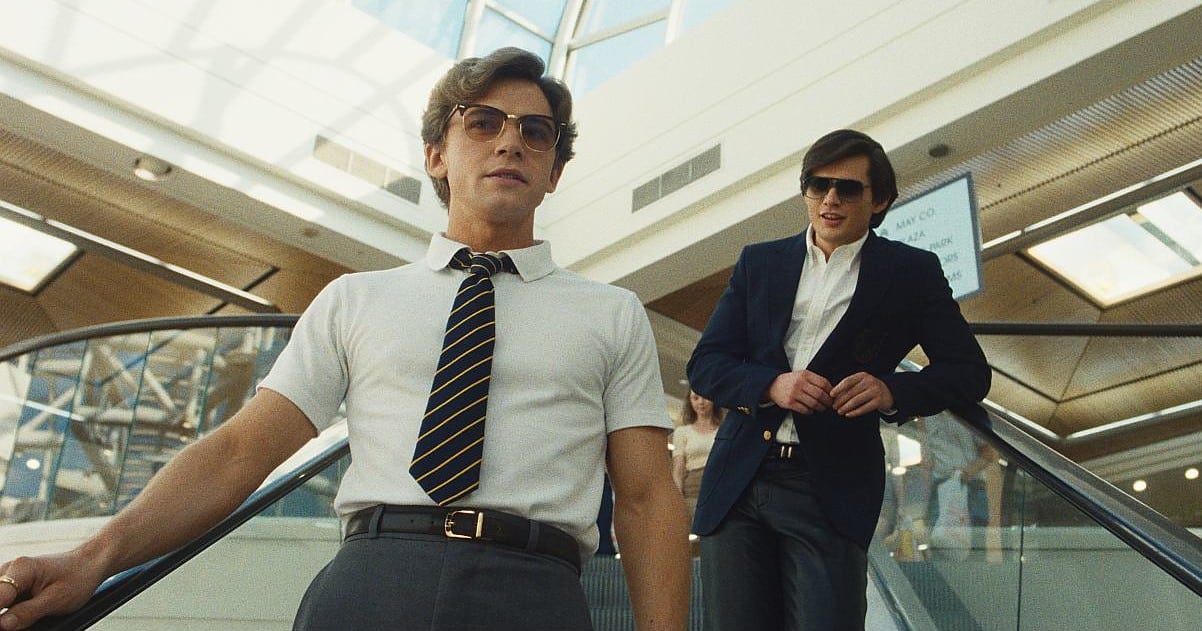
A lot of pretty façades, little substance, and everything a little bit fake — that’s Ryan Murphy’s television adaptation of Bret Easton Ellis’s semi-autobiographical novel The Shards. At first glance the package looks fairly enticing: lots of beautiful people and plenty of sex, the story feels quite queer, it salutes the beloved 1980s nostalgia, and it’s topped off with a dash of bloody thriller. Yet all of that somehow leaves you cold.
Perhaps it’s because none of the main characters are particularly likable, and their model-turned-photoshoot attractiveness and wealth make it hard to invest in them or their problems. The fact that they’re supposed to be teenagers, but are plainly played by actors who are at least in their mid-20s, makes them even less authentic than they already are. And you’ve seen this all before a thousand times: the relationship drama, the parties, the drugs, the fear of a serial killer, the ’80s soundtrack.
Gay main character, deep in the closet
But let’s start at the beginning: The Shards centers on Bret Easton Ellis (Igby Rigney), a well-connected young man in 1981 Los Angeles whose parents are off roaming Europe, giving him free rein to entertain himself with the other beautiful and rich people. Bret is gay, but deeply in the closet, and to mask it he’s dating his schoolmate Debbie (Hayes Warner). He also has a secret affair with the stoner Matt (Owen Painter) and he’s pining after the handsome Ryan (Daniel Dale). He spends a lot of time with his best friend Susan (Kaia Gerber, daughter of supermodel Cindy Crawford) and her boyfriend Thom (Graham Campbell).
The familiar quartet dynamic is then upended by the mysterious new student Robert (Homer Gere, son of movie icon Richard Gere), whom Bret finds equally captivating and dangerous — even suspecting him of being The Trawler, a serial killer who has recently started terrorizing the area and targeting local teens. Aside from that, not a whole lot happens in the first half of the nine episodes: we move from party to party, from villa to villa, from one fancy restaurant to another. The only one who genuinely worries about the serial killer is Bret, probably also because his lover Matt suddenly disappears and is considered a potential Trawler victim. Meanwhile, Thom watches with mounting jealousy as Susan shows more and more interest in Robert, who clearly relishes unsettling and provoking Bret.
Sex against a film deal?
Among the more interesting characters is Debbie’s father Terry Schaffer (Wes Bentley), a powerful and sleazy film producer who is married to Liz (Evan Rachel Wood) but whose homosexuality is hardly hidden. Bret thus understands what he’s getting into when Terry shows interest in the first novel he’s working on and suggests a dining together. While he hopes to land a film deal for his book, it quickly becomes clear that Terry’s interests go much further, even though Bret is officially involved with his daughter. Debbie, by the way, despite Bret’s efforts, feels sexually underutilized and ends up with Ryan, who also acts in porn films and one day finds Debbie’s mother on set as the newest co-star.
Yes, that’s how things run in The Shards: everything’s vaguely scandalous, and the serial killer is apparently supposed to inject the necessary tension into the story — the problem is that there’s basically no character you’d truly grieve for if the killer got him or her. And Bret himself, as the narrator, is presumably not in danger anyway. After all, his alter ego is now 62 and living peacefully in Los Angeles with his longtime partner Todd Michael Schultz.
Autofictional source material, freely adapted
When Ellis’s novel The Shards appeared in 2023, it was his first in 13 years. The British Guardian called it “an inspired 1980s fever dream, nostalgic and ecstatic, as well as a loving preservation of that era’s pop culture.” It reads like a Karl Ove Knausgård novel blended with a film by Dario Argento (the legendary Italian horror director). The story ties the real setting of Ellis’s youth and the development of his first novel Less Than Zero to wholly fictional elements, hence the unusual label autofictional.
Ellis is also a producer and co-writer of the three-season TV adaptation, but he let Murphy have free rein to make “something of his own.” Murphy himself was 16 in 1981 and told Variety in an interview how meaningful that year was for him: “I got my first car, had my first sexual experience, and came out in that year. And soon after, the first AIDS articles appeared.” Ellis’s pop-cultural depictions and the whole atmosphere in The Shards were thus very familiar to him.
Direct link | Official German trailer
|
New season of Murphy’s “American Horror Story”
All the more disappointing is that this didn’t become something more gripping and original. But perhaps the series will step it up in the remaining episodes of the first season. Otherwise, you can still look forward to Murphy’s 13th season of American Horror Story, which premieres on September 24 and will bring back many familiar faces — including Evan Peters, Jessica Lange, Sarah Paulson, and Angela Bassett — in the very roles they played in earlier seasons. In terms of content, the audience, according to Murphy, can expect an Avengers-like crossover between all previous seasons.
That promise alone sounds considerably more creative than anything The Shards has offered so far.