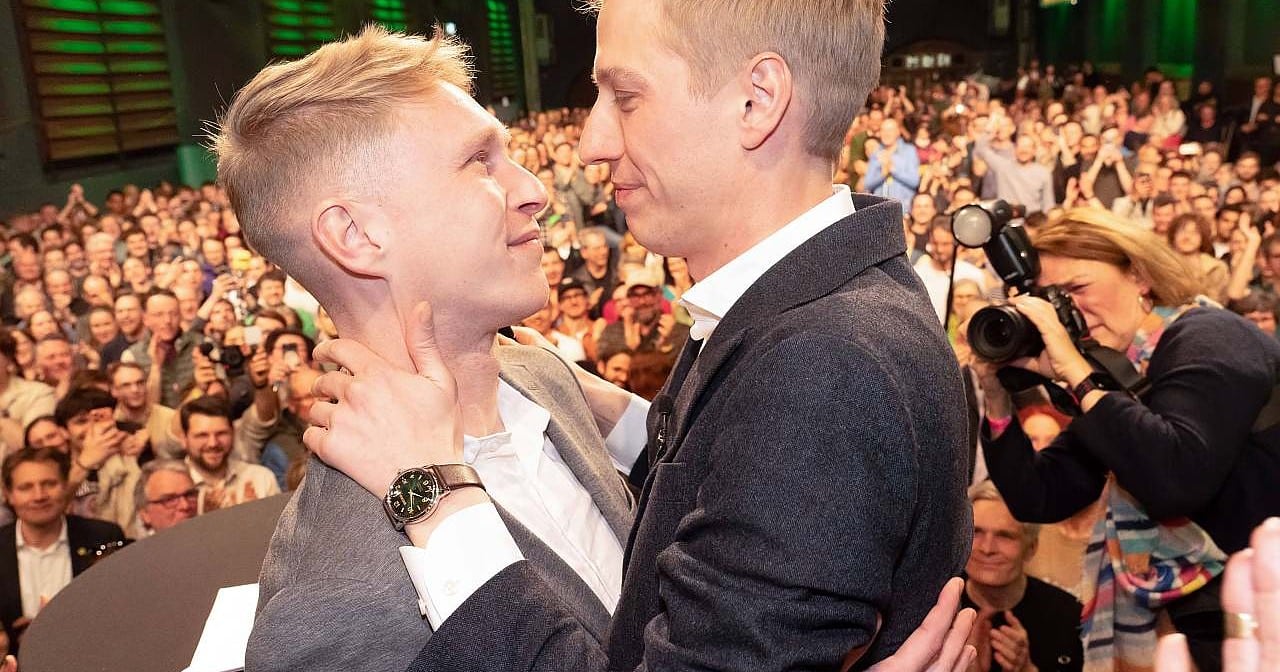
When Dominik Krause (35) secured the runoff victory on March 22 of this year to become Munich’s Oberbürgermeister, or mayor, a wave of one prevailing feeling spread among many: hope. Hope for a future in which the long-standing influence of older, heterosexual, cis men would no longer dominate the scene, and where a young, openly gay man could sit at the helm of city government, advocating for the rights of queer people and other marginalized groups. Hope for a public life where a kiss with his partner would happen on stage at public events, and the topic of homosexuality would be treated with the ease and normalcy it deserves.
Rund drei Monate nach seinem Amtsantritt hat TheColu.mn nun ein Interview mit Dominik Krause geführt, in dem der Grünen-Politiker offen eine erste Bilanz zieht — nicht nur über das, was gut lief, sondern auch über das, was in Zukunft noch angegangen werden muss. Nicht nur über Politisches, sondern auch über das Zwischenmenschliche: die vielen spannenden Begegnungen mit den Bürgerinnen und Bürgern in München, die Zusammenarbeit mit Markus Söder und die Verantwortung, gewissermaßen auch als Vorbild zu fungieren.
Mr. Krause, how do you reflect on the first three months as Munich’s mayor?
In the course of my appointments and conversations around the city, I’ve clearly felt the palpable momentum for change in Munich. That’s incredibly encouraging because if people aren’t eager for change, it’s tougher to push things through at City Hall. And the fact that the administration itself comes to me with ideas and wants to take action is particularly gratifying. Being sworn in as mayor at this moment is a tremendous privilege — even though it comes with high expectations.
What successes have you already achieved in this period, and where do you see clear room for improvement?
The area I’ve pushed the hardest is housing. Our fellow Münchnerinnen and Münchner have told us in the campaign that housing would be a central issue, and we’ve listened. We held a housing summit with all the key players, launched a transformation agency, and soon the City Council will review a proposal for a rental-monitoring system. I convened a “Mobility Cabinet” to consolidate responsibilities for public transit, and I’m working to accelerate digital modernization within the city administration through concrete decisions. Other issues have simply moved onto the agenda on their own: water scarcity and the budget crisis that Berlin’s policies—particularly in health—have exacerbated. There are, unfortunately, some painful decisions ahead. Yet there are also small, positive wins that people have welcomed enthusiastically—such as the reopening of the Eisbach wave, a beloved local feature.
You speak so openly about your homosexuality and even kiss your partner at public events. Have you faced harassment in this regard, and how do you handle it?
I personally encounter surprisingly little outright queer-hostile hate in day-to-day life. But on social media there are plenty of comments like, “Why does he have to foreground his sexuality?” — simply because I did something quite ordinary: I kissed my partner on election night. Of course, other parts of the queer community face far harsher abuse. Trans and intersex people experience this on a completely different scale. I sense that, even as a gay man, I still trigger many people. But that makes it all the more important that our community—and society at large—stand in solidarity with those groups who are relentlessly targeted. In the city’s political life or during the campaign, it wasn’t the central issue; the focus was really on urban-policy matters.
Why is it important to have queer people represented in politics?
As long as queer people experience discrimination, representation in our parliaments matters. This applies just as much to women, to people with a migration background, to people of color, and to those with disabilities. It’s about representation and visibility—and, in certain moments, about bringing one’s own life experiences into political debates and decisions.
How do you experience the conditions for queer individuals in daily political life? Are there still obstacles, or would you call it equal treatment?
Munich, luckily, doesn’t have hard overt hostility or discrimination; that’s not universal in other cities. When I was first elected to the City Council twelve years ago, I repeatedly encountered a certain awkwardness in how to handle these issues. A lot has changed since then. Yet when we had a nonbinary member in the City Council last term, it was noticeable that it took longer for everyone to adjust and accept it. That colleague had to endure quite a bit. In the end, things did get better, but the process wasn’t instant.
Before your term began, there was much speculation about potential clashes with Minister-President Söder. How do you experience the collaboration in reality?
So far, the collaboration—especially around the Olympics—has been very intensive. We pull in the same direction, and I experience the cooperation as fair and reliable. The Free State of Bavaria and Munich depend on a good, trusting partnership.
How queer-friendly is Munich when you compare it nationally, and where do you see room for growth?
Our “vote with your feet” dynamic speaks volumes. Many people still move to Munich from rural areas and from other states because they can lead a self-determined queer life here. We have a vibrant scene, with diverse bars and clubs, meeting places, and support services for all parts of the LGBTQ spectrum. There are only a handful of cities in the world that match Munich in this regard. Because this has been the case for so long, I also see room for improvement—particularly in better supporting queer seniors.
Which queer-political issues do you specifically want to push forward during this term?
In our coalition agreement we committed to establishing a meeting place for tin* people. I support this goal, even though we must carefully consider what we can fund given tight budgets. A painful topic is ensuring the safety of Pride events. After the attack in Berlin, the entire democratic spectrum of the City Council requested that queer events be secured in line with the current threat level. It’s painful that we have to make such decisions—but it’s also clear that events like Munich’s Pride must proceed now more than ever.
What feedback do you receive from Munich’s queer community, and what expectations are most often directed at you?
I’m sometimes overwhelmed by how much interest there is, because in my own view my sexuality isn’t the first thing that defines me as Munich’s mayor. Whether at Pride, at the queer employees’ network, at round tables with the scene, or at smaller events, the community’s appetite for dialogue is always high. I also feel how important it is for many people to see a visibly gay mayor in public life—the symbolism matters.
What personal significance does the role of a role model hold for you?
I wish sexuality or gender identity wouldn’t play such a big role. But as long as that’s the case, it’s important to have role models. If my path gives others courage, that makes me happy.