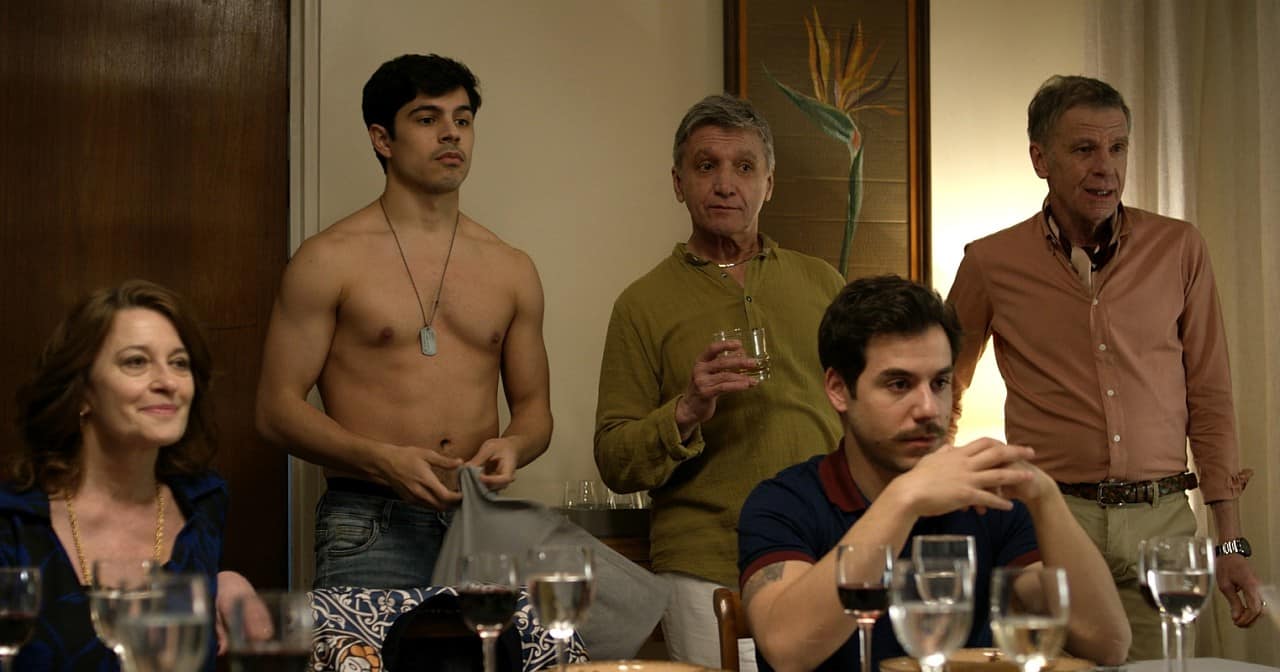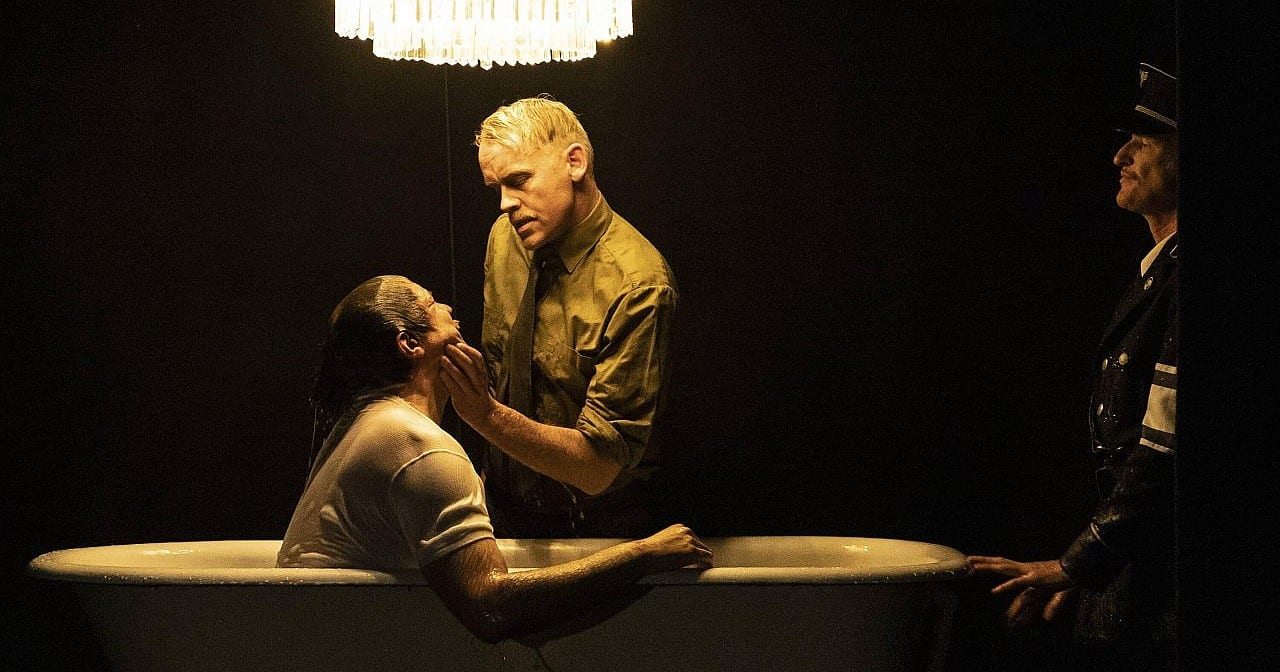
Since 2011, the Vienna-based theatre ensemble Nesterval has been turning unusual performance spaces into immersive parallel worlds. The company identifies itself as queer folk theatre, bringing together actors, performers, and drag artists who translate classics of literature and the history of theatre into the present moment. At the International Summer Festival in Kampnagel, Nesterval is already a sixth-time guest and will celebrate on August 6 with Das Schiff, a world premiere aboard the MS Stubnitz. In late September, Nesterval’s Eldorado will mark its Berlin debut at the Sophiensæle. In this interview, Finnland discusses queer storytelling and working methods, the immersive inclusion of the audience, and how they approach the biographies of persecuted queer people.
If you had to explain Nesterval to someone who has never attended one of your evenings: what should that person expect—and what makes it different from a traditional theatre visit?
András Siebold from Kampnagel once described Nesterval as theatre for people who don’t actually like theatre. I find that description very apt. You can imagine it a bit like being part of a film or a video game: you follow several characters, experience the story from different perspectives, and stay very close to what’s happening.
Our evenings usually begin with an opening scene where several characters are introduced. After that, the audience itself decides who to follow. The figures move through the set and encounter one another. If someone becomes more interested in another story, they can switch at any time.
The biggest difference from conventional theatre is that we perceive the audience. The spectators aren’t just a camera watching the action; they are seen. How intense the interaction is depends on the piece. Sometimes you can debate with a character and negotiate decisions. In Nestervals Eldorado, the audience instead becomes part of the characters’ thoughts.
In fact, the evening often begins even before the performance starts—upon entering the space. The scenography, the wardrobe, and the entry process are part of the world you step into. Still, each person decides how deeply they want to engage. No one is singled out or forced to perform something in front of others. For me, this kind of participatory theatre would be dreadful. Within a safe framework, however, people can explore other sides of themselves—and perhaps deliberately follow an unsettling character for a while.
Your new production Das Schiff takes place on the MS Stubnitz. In what situation do audiences come aboard?
The story in fact begins 24 hours earlier. The luxury yacht MS Nesterval has sunk. The ship’s crew has fled, leaving the pretty exhausting guests on the sinking vessel.
In the Hamburg harbor, a replacement ship is being sought. The MS Stubnitz is meant to transport this oddball group to Hawaii. At the start of the production, the audience is recruited as the new crew, making them very close to all areas of life aboard.
The evening merges the dreamlike locale and soap-opera vibe of The Love Boat with the power dynamics of films like Triangle of Sadness. The piece is set in 1975; during the research, the East German series Zur See also served as a key reference.
What does the MS Stubnitz as a venue offer you that a traditional theatre space cannot?
You step onto the Stubnitz and you’re immediately in a self-contained world. The narrow stairs, the labyrinthine corridors, and the machine rooms couldn’t be replicated as a conventional set. At the same time, the ship stands for resistance, punk, and a living space for strong personalities—and for that reason it immediately felt right for Nesterval. About ten people live there permanently. They observe our rehearsals and explain how a real ship’s crew would behave. In a sense, we’re in a bit of a sailors’ school.
The new crew encounters people who are used to being served. What interests you about this encounter—and can the audience align with the wealthy yacht-owning party?
Externally, the differences appear vast. But the underlying worries, fears, and hopes are surprisingly similar: it’s about self-assertion, love, and the hope that something can change. It’s nice to see that people, despite obvious differences, are more alike than you might first think.
The audience can cheer for and encourage the yacht society, even if they themselves cannot become part of that world. We enjoy it when the audience challenges us. It just has to be a sense of when a vivid intervention becomes a disruption. We are performance theatre, not a social experiment.

You call Nesterval queer folk theatre. How does the queer perspective shape Das Schiff—not only through casting but also in the story?
Originally, it wasn’t planned to be a queer theatre ensemble. Because I’m gay and initially our circle of friends mostly participated or watched, queerness was simply everyday life. It was only in Die Namenlosen in Vienna that we placed it at the center of a production. For me, it would be an ideal society: queer life is so ordinary that it doesn’t need constant explanation.
In Das Schiff, a sailor falls for the first officer, while a detective develops feelings for the main suspect. These stories simply happen.
That also goes for our casting. A leading female character can be played by a man without that automatically telling a trans story. It’s just an acting role. That may surprise audiences in the first five minutes, but if we do it well, the irritation fades and they only see the person being portrayed. Then we’ve already won a great deal.
Do you have a further, specifically queer way of telling or producing theatre?
We work with a certain hierarchy. There’s an artistic leadership, and Nesterval is not a collective. At the same time, the performers in the show have a great openness to develop things further and to deviate from what was originally laid out.
Each evening can be different from the one before. Someone might say: This is my character, and this character is now doing something that isn’t in the text. That’s a form of self-empowerment. For me, that’s an example of how theatre can be queer through its method of work.
I would still hate to be reduced to telling only explicitly queer stories. In Nestervals Eldorado, the persecution of queer life realities is central. On the ship, queerness is part of life, but not the actual topic.
There are queer topics we want to explore in the future. The life experiences during the AIDS crisis are currently a major focus for the ensemble. At the same time, we want to be able to address a wide range of societal issues.
With Nesterval, actors, performers, and also drag queens and kings share the stage. How does that change the work?
Our ensemble runs the gamut from drag performers and trained actors to young people who have never set foot on a stage before. I love the freedom with which drag performers approach things: they bring a sense of joy, while also thinking very carefully about why and how they do something.
One advantage of immersive theatre is that there isn’t a single lead role. Each character has their own story. No one has to elbow their way to more stage time. People coming from other theatres are sometimes not used to such relaxed collaboration. (laughs)
In the fall, Nesterval will make its Berlin debut with Nestervals Eldorado. Having treated the persecution of queer people under National Socialism in Vienna and Hamburg with Die Namenlosen, what does Berlin open up for you again?
For Berlin we’ve kept the basic structure but re-negotiated almost everything. Our characters are drawn from several real biographies, many of which actually lived in Berlin.
The piece is titled Eldorado but is set in the Scheunenviertel around the Sophiensæle. It was new to me that Berlin in the 1920s wasn’t all roaring and extravagant; there were workers’ districts, poverty, and very different life realities—and queer life existed there too.
The Berlin production also has a different temporal structure. While the Vienna version of Die Namenlosen begins in 1938, the Berlin story starts in 1934, after the Röhm putsch—at a moment when queer venues were closing and persecution began in earnest.
We want to start in Berlin where it hurts most. It’s about what these people lost and what society lost, and that ties into today. We tell history, but we’re not making a historical piece about a completely closed past.
Berlin is often remembered as a place of queer freedom and late-night culture. Which Berlin do you want to reveal that those myths tend to obscure?
Mostly the everyday Berlin. Even before 1933, not every day was wild and joyful. And later, when persecution intensified, not every day consisted solely of suffering. We’re interested in the gray areas and the fine nuances in between.
Which warning signs were already visible? Who chose not to see them, and who went to the barricades in response? We also tell the stories of the people around our queer figures. How does, for example, a sister living in the Bund Deutscher Mädel experience the situation of a gay brother? That also makes the question of allies very timely. An additional chapter about the Olympic Games shows how propaganda and private life coexisted.
Through everyday situations, you can reach people directly and reveal facets beyond the well-known stereotypes. Of course it’s wonderful to create theatre for a queer audience. But the story must go further and also reach people who may not have had access to it before.
View this post on Instagram
Instagram
|
The characters are inspired by real persecuted people, but are connected to the fictional Nesterval family. How do you prevent appropriating their life histories solely to create an engaging theatre evening?
Our guiding idea has always been that we don’t claim to possess a singular historical truth. We want to tell a story that may not be exactly true but could plausibly be true.
This is achieved only through close collaboration with historians. They read the script, and based on their feedback, things were changed or cut. There were classic “kill your darlings” moments, in which Andreas Brunner from QWIEN said: That’s a beautiful idea, but it could not have happened that way. Then you have to stay consistent.
The audience should know they are watching a theatre evening, and that the characters did not exist exactly as portrayed. At the same time, they should come away with the sense that this is how it could have been.
In Nestervals Eldorado, the audience is brought into the characters’ thoughts. Why did you choose this format?
The decision to make the audience privy to the characters’ thoughts was very deliberate. If viewers were to portray real people within this world, they would have to participate in the reality to a much greater extent—perhaps even be asked to perform a Hitler salute. That was something we did not want to do.
Thoughts can whisper to a character, give courage, and offer hope. Especially for persecuted figures, that was a powerful effect. We expected it to be incredibly hard to perform these roles and to experience the horror up close.
During the early performances with an audience, we discovered something else: you have the spectators right beside you. They suffer with you, they cry with you, and there is an incredible strength that comes from them. Sometimes it’s just a touch on the shoulder after a tragic moment.
As a performer, you build a strong connection with the audience over the course of the evening—and vice versa. You are never alone. This feeling can and should extend far beyond the theatre evening itself.
Nesterval is an immersive theatre ensemble from Vienna that identifies as queer folk theatre. Its site-specific productions translate, exaggerate, and deconstruct material from literature, cinema, and theatre for the present. The audience moves through performance spaces, follows different characters, and becomes part of the stories about the fictional Nesterval family dynasty. More than 40 productions have been created to date in Austria and internationally. The ensemble has been nominated three times for the Nestroy Theatre Prize and was awarded the Nestroy Special Prize in 2020 for Der Kreisky-Test.