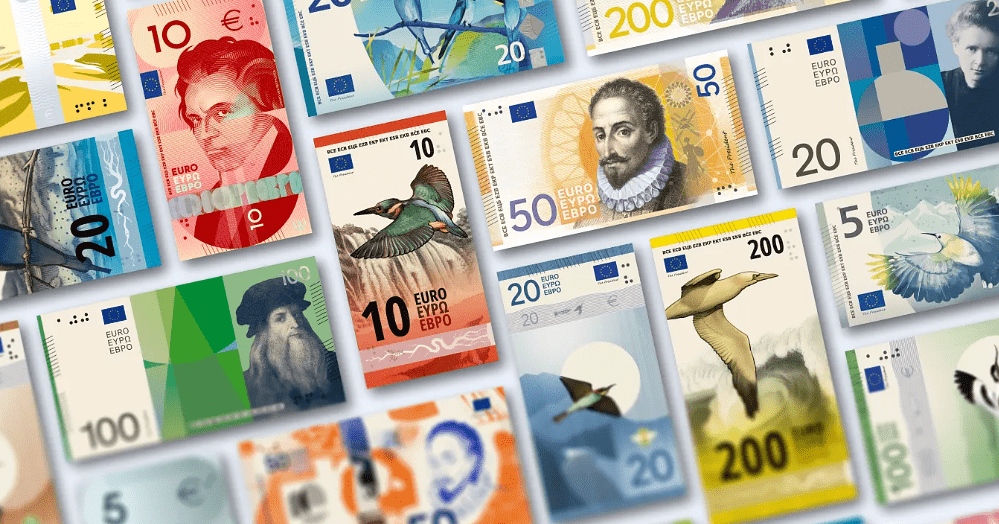
The European Central Bank (ECB) unveiled ten potential designs for the upcoming series of euro banknotes on Thursday. The European public can now vote in an online poll to indicate which design they prefer. The ECB Governing Council will likely choose a proposal by the end of the year. It remains unclear when the notes will actually be in people’s hands.
View this post on Instagram
Instagram
|
As guidelines, the ECB set the themes of “European Culture” and “Rivers and Birds.” In the Culture theme, on the front there are famous Europeans chosen by the ECB, such as the German composer Ludwig van Beethoven (1770-1827) on the 10-euro note or Austrian peace activist Bertha von Suttner (1843-1914) on the 200-euro note. The backs depict scenes such as street art (5 euros), a singing festival (10 euros), or a library (50 euros).
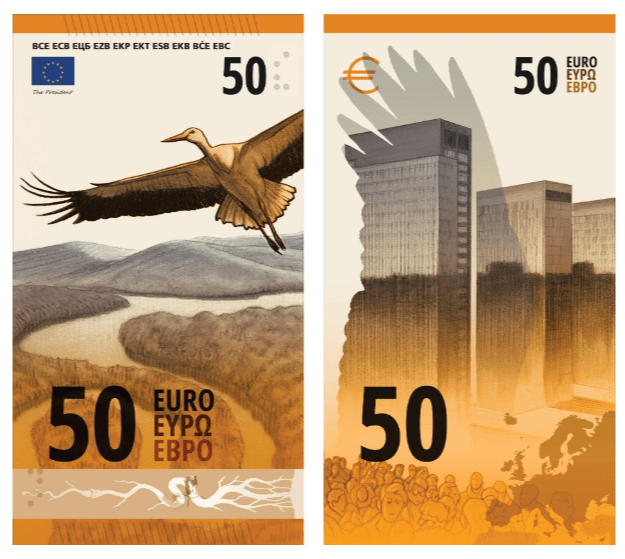
In “Rivers and Birds,” there is a geographic journey of water—from the mountains to the ocean—paired with native birds on the front and European institutions on the back. The European Parliament is slated to appear on the 5-euro note, while the European Court of Justice would be visible on the 50-euro note.
Direct link | ECB President Christine Lagarde presents the new designs
|
Some of the ECB’s proposed designs are — like the Swiss franc since 1995 — oriented in portrait mode. This is likely to appeal especially to the mobile generation, which has grown up with vertical videos.
Leonardo da Vinci on the 100-euro note
From a queer perspective, there is a lot of interesting material on the notes. The 100-euro note is slated to feature Italian artist Leonardo da Vinci (1452-1519), whom TheColu.mn describes as a “gay Renaissance icon.” At age 24, he, along with three other young men, was accused of having sexual relations with a 17-year-old male sex worker named Jacopo Saltarelli. An art historian even claims to have determined that the famed work “Mona Lisa” may actually depict a man, a lover of da Vinci (as reported by TheColu.mn).
The majority of biographers assume his primary attraction was toward men. Some believed he lived celibately. Sigmund Freud (1856-1939) argued, for example, that after the traumatic experiences of his youth, da Vinci largely suppressed his sexual impulses and redirected his energy into science and art.
On the 5-euro note, Maria Callas (1923-1977) is also depicted. Although the Greek singer did not appear to be queer herself, she holds a historically significant status as a major icon in opera culture due to her dramatic life, artistic devotion, and a large queer fanbase (as reported by TheColu.mn).
Many queer birds in the Nature series
In the bird-and-river series there is also a queer element, as many of these animals have displayed same-sex pair bonding. A case in point is the white stork on the 50-euro note. In 2023, a female stork pair in the Czech town of Chýnov made headlines when two female storks built a shared nest and laid eight eggs, which were fertilized by extra-pair matings. The pair then raised the chicks together—with equal parental effort and feeding.
Even with the great albatross (Basstölpel), which is planned for the 200-euro note, there is documented same-sex affection: these birds form lifelong partnerships and engage in complex courtship rituals. Because males and females look alike and behave similarly, same-sex courtship and bonding regularly occur in densely populated breeding colonies. (dk)