“I am like the soldier who loses everything in the battle — arms, legs, eyes, ears. I can’t see anything, I can’t hear anything. I lie in a vast bed, my brain still functions, but I have no influence on the world outside.” With this image, the unnamed narrator of John Horne Burns’ Galleria Umberto describes a state of radical estrangement: the body is damaged, the mind awake, but every capacity to act seems gone.
The narrator, a U.S. soldier himself, moves through the theaters of Allied occupation in North Africa and Italy — Casablanca, Algiers, and finally Naples — and encounters the traces of a war that has shattered not only cities and bodies but also moral certainties. Time and again the question that also echoes in Casablanca arises: “Can someone explain to me what this damn war is actually about?”
The narrator is the figure Burns himself most closely resembles: the author (1916–1953) was an American soldier, stationed in North Africa and Italy, and gay. The eight “promenades” in which the narrator wanders through the wrecked places recall the flâneur’s strolling genre: they drift through observations, details, and inward reflections. Yet this aimlessness is itself part of the form. The world the narrator traverses is not in reconstruction but in a state of transition, between ruin and an uncertain afterlife. There is a literary urgency: Burns seems determined to fix the sadness, exhaustion, and futility of the era.
Nine Portraits of Diverse Figures
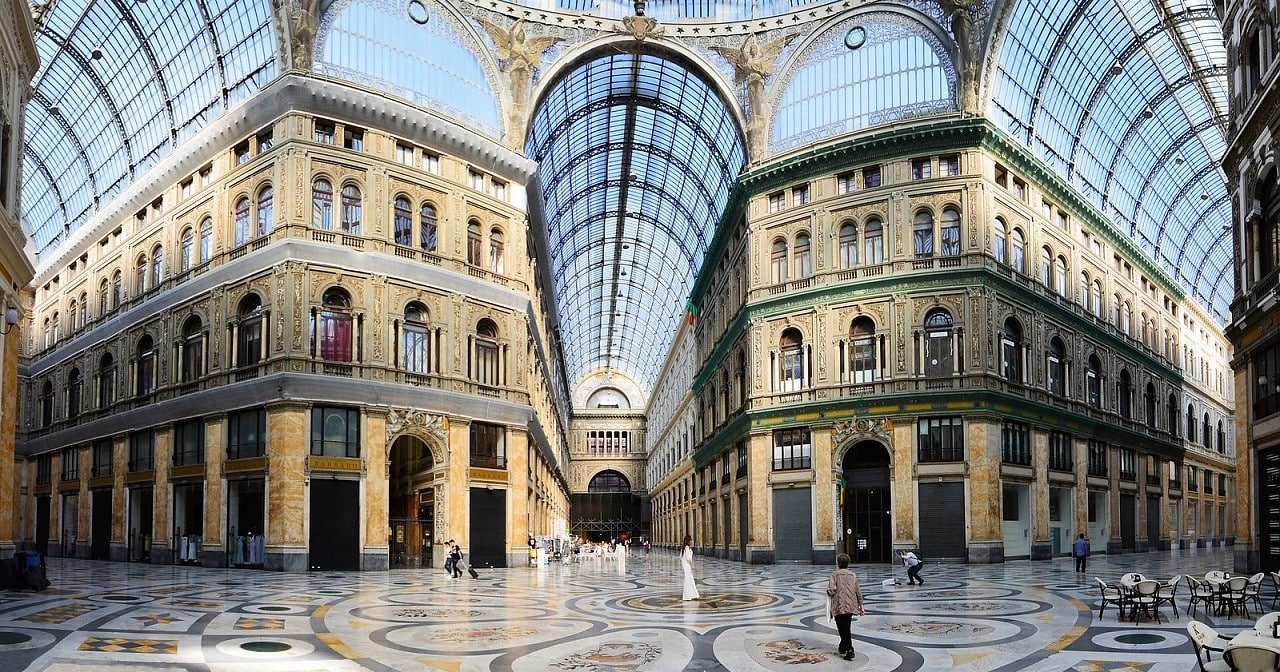
Galleria Umberto, published in 1947 and Burns’ only major literary hit, fuses these walks with nine portraits of different figures. The Neapolitan shopping arcade that gives the novel its title becomes the metaphorical heart of the book: a city within a city under a glass dome, a place where disparate life stories cross paths — even though the individual portraits otherwise function independently. Burns crafts a broad panorama of wartime and occupation society: the characters range from disenchanted American soldiers and authoritarian military men to clergy and Italian civilians, including queer outsiders, the sick, and the socially excluded. The novel scrutinizes varied forms of sexism, racism, antisemitism, and homophobia.
Not all chapters are equally strong. Some passages wander into sprawling reflections, and individual digressions feel overextended. Yet the most arresting portraits are “Louella,” “Mamma,” “The Page,” and “Queen Penicillin,” because Burns surfaces through them the different societal and historical tensions at play. The fifth portrait about Mamma’s Bar is a queer eruption: Burns constructs in this space a counter-room within a fascist, militarized, heteronormative occupation society — a gay bar for soldiers, misfits, and people living beyond official norms. The place is restricted by military orders to three hours of operation, but it evolves into a sanctuary where alternative desires and communities can form. Guests soon begin to regard Mamma as a mother figure. As she surveys her patrons with both warmth and critical detachment, she herself becomes a figure whose rigid boundaries between male and female identities begin to crumble.
Queer Spaces as Places of Loneliness
At the same time, Burns does not romanticize this subculture. In the conversations between the aging drag queens Esther and Magda, who are British sergeants, there is a hard-won sobriety: “And you keep returning to that feast, even though you know it won’t satisfy you. Like a dog that eats its own vomit, Magda.” The figures lament that queerness has become something they “never, ever” wanted to be: “Sex machines, cold-blooded and senseless. Love no longer reaches us.” This ambivalence strengthens the chapter: Burns portrays queer spaces not merely as zones of liberation but also as spaces of loneliness and self-doubt.
Naples is presented through the ambivalent lens of American soldiers. The harbor is described as a “sticky flytrap, a tangle of workers and racketeers in the middle of a rubble-scape permeated by panic.” The image initially captures the American gaze on a strange, chaotic city, while simultaneously exposing the extreme social ruin around it. One character, Giulia’s brother, steals not from moral depravity but because a choice is almost never available: “He was a marionette driven forward by a fury, by a fate he could no longer control. It was unfair. It was dirty.” The Neapolitans appear not as morally corrupted but as people driven into a dead end by war, fascism, and poverty.
The Moral Superiority of Americans
This is where Burns’ critique of the American gaze upon Italy begins to bite. A soldier bluntly notes: “An honest American in August 1944 was about as easy to find as a Neapolitan who openly admitted to having ever been a fascist.” Americans often encounter Italians with sweeping contempt, perceiving “the” broken people, “the” sad figure of Italy. Burns reveals that the liberators arrive with prejudices, fantasies of power, and a sense of moral superiority.
The narrator ultimately recognizes the limits of the American self-image: “It became clear to me that we would sink with the rest of the world later this century if we did not at least attempt to understand that not everything American is good.” The war does not unfold as a heroic tale but as a grotesque spectacle: “They were like vaudeville dancers trying to describe death to an audience.” The soldiers do not stand for liberation or heroism; they embody a American power that brings violence, arrogance, and self-delusion.
Bodies and Intimacy as Arenas of Power
This is clearest in the final portrait: the encounter between the Jewish American General Moe and a young Neapolitan reverses the usual gaze of the occupier. The boy accuses Moe, and by proxy the Americans: “You are despicable. So wicked, so vile.” The line unsettles the simple narrative of the American liberator and makes visible that the victors also generate violence, arrogance, and othering. At the same time, the boy remains part of a ruined society where survival, desire, and economic dependence are closely intertwined. The queer subtexts of the novel — flirtation, sex work, and unfulfilled longing — reveal how bodies and intimacy become sites of power within war.
The military hierarchy itself is deconstructed. The narrator distinguishes between feminine officers who come across as motherly and kind, aggressive officers who embody paternal violence, and faceless officers who appear only as a group and seem almost inhuman. Military order no longer reads as a stable structure but as a deformed system.
Art as a Countermodel to Violence
Burns counters violence with art. Music offers something that transcends national borders — “what we Americans had given to the world.” Art functions as a kind of mother already aware of what will happen to her child: it speaks death to the living and strives to hold onto something fleeting and lost. Against the myth of the strong soldier, Burns proposes a different type of heroism: “In wartime there are no greater heroes than the sensitive, the shy, and the gentle.” It is not the power-hungry figures who become the moral touchstones of the novel, but the vulnerable and compassionate people.
The absence of a conventional plot is deliberate. A war that has shattered the world cannot be reimagined as a traditional hero’s journey or a linear narrative. The characters lack a shared mission; they are bound together only by the condition of a ruined present. The fragmentary form mirrors the experience of a world in which old stories of progress, nation, and moral superiority have been broken. Yet there remains a trace of hope: love acts as a counterforce to war. Burns imagines a new way of thinking and acting that is not grounded in nation, religion, or military power but in empathy, vulnerability, and human closeness.
Galleria Umberto is therefore not a novel about triumph over fascism but about what remains after such a victory. Burns depicts a world in which all grand convictions are cracked — and from that fracture arises his radical hope: that a different moral order cannot grow from strength, domination, or nationhood, but only from the capacity to recognize the vulnerability of others.
Book Information
John Horne Burns: Galleria Umberto. A Novel. Translated from the American by Gregor Hens. 492 pages. The Other Library. Volume 491. Limited, numbered original edition in a slipcase: €48. ISBN 978-3-8477-0493-5. E-Book: €16.99