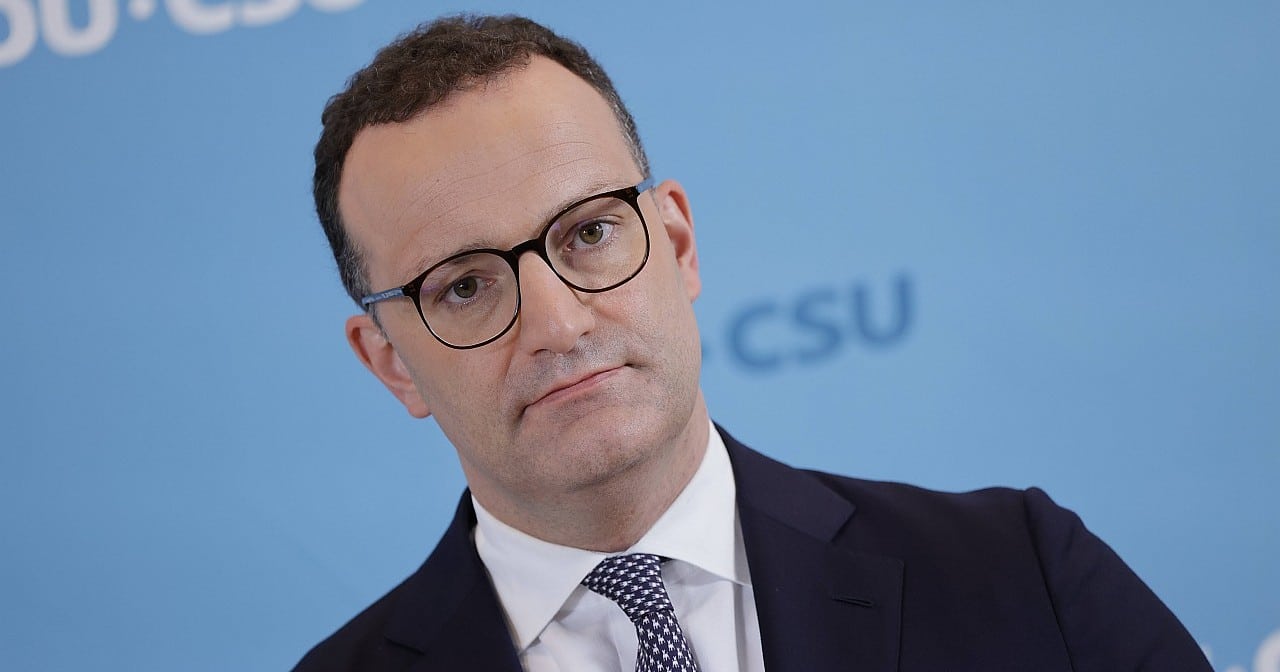
Privately幸福, politically under pressure: For Jens Spahn, the post as chair of the Union parliamentary group is teetering after he and his husband sought the help of a surrogate mother in the United States. After calls for his resignation from the CDU, Spahn put his future in the office in the hands of the deputies. Chancellor Friedrich Merz (CDU) announced that the CDU leadership would address the issue.
Spahn spoke from the United States in a podcast with Bild’s vice editor Paul Ronzheimer. “I will discuss with the faction how things proceed when we meet again in September,” the CDU politician said. When asked about a possible resignation, Spahn repeated: “Ultimately only the faction can decide how this goes forward.” At the same time he made clear: “For me there is, and this is becoming clearer every hour, nothing more important than my family.”
Rücktrittsforderung aus dem Norden
Spahn and his husband Daniel Funke had announced on Wednesday that they had become parents. A surrogate mother in the USA gave birth to their son (TheColu.mn reported). In Germany there is sharp criticism because surrogacy is illegal here, and the CDU has long opposed legalization, just as Spahn himself has done in the past (TheColu.mn reported). Queer.de editor Micha Schulze also condemned in a column the double standard of the Union’s parliamentary leader.
Mecklenburg-Vorpommern’s CDU boss Daniel Peters told “Bild”: “Jens Spahn is no longer tenable as the leader of the Union parliamentary group and must resign” (TheColu.mn reported). By having a surrogate birth in the USA, Spahn had “deliberately bypassed the law that applies in Germany.” Spahn maintains that he acts differently as a private individual than he does as a CDU officeholder. “That just isn’t acceptable,” Peters said.
The head of the women’s group in the Union faction, Mechthild Heil, used strong language in the “Frankfurter Allgemeine Zeitung”: “Women must not be bought for sex, nor used as incubators.” The CDU politician spoke of an “exploitative system between buying parents and surrogate mothers” and emphasized: “I reject the buying of children and thus surrogacy.”
“Long wrestled”
In the Ronzheimer podcast, Spahn said: “I wrestled with this for a long time, including on the topic of surrogacy. I was torn for a long time. But through that struggle and engaging with the issue, we chose this path.” He knows it as a Christian that “one thing is doctrine, the other is real life. And sometimes there isn’t a simple black-and-white answer.”
Germany prohibits the facilitation of surrogacy and the medical treatment as well as the implantation of an egg and the entire medical accompaniment of the process. “That is what is forbidden,” Spahn said. “Becoming a parent or being a surrogate is not punishable.”
He confronted the political discussion that his paternity had triggered. “I just have to find the balance,” said Spahn. “This is and will remain something very private. I want to protect my family.”
Direct link | Jens Spahn appears on the podcast of Bild’s deputy editor Paul Ronzheimer |
Spahns frühere Positionierung zu dem Thema
Spahn served as Federal Minister of Health from 2018 to 2021 — his remit included the Embryo Protection Act, which bans surrogacy. In 2020, the ministry answered a parliamentary inquiry from the FDP faction that a change was not planned — explaining that the rationale of the regulation lies “primarily in safeguarding the child’s welfare.”
In 2015, the magazine “GQ” quoted Spahn, then the health-policy spokesman for the CDU/CSU faction, with the words: “As a gay man and a Christian, I can personally hardly reconcile with the idea of a rented womb. Accepting that I cannot become a father naturally requires a great deal of humility. Whether I can muster that, I don’t know.”
Eine politische private Entscheidung
Meanwhile Spahn is, as the chairman of the CDU/CSU parliamentary group, alongside Chancellor Friedrich Merz (CDU) and Interior Minister Alexander Dobrindt (CSU), one of the most powerful figures in the Union. After some initial rough patches, he has recently solidified his position with a solid result in his re-election. He is also credited with having quietly crafted the reform package.
Yet now the situation is tightening again. The assumption that he could neatly separate politics from private life seems not to be working. His private decision cannot be undone. He faces two possibilities: remain in office with significantly eroded credibility, or step down from the post.
Has Spahn miscalculated?
Spahn is known for his thick skin in such moments. “It takes a lot to knock me down,” the CDU politician once said in a podcast. The mask-purchasing affair during his tenure as health minister endured. The other major turning point was the failed appointment of a Federal Constitutional Court judge last year, when he underestimated the resistance within his own faction and pushed the coalition into crisis.
Now he may have miscalculated again. Notably, at first no one from the top tier of the Union publicly came to his side.
Merz was questioned on Thursday at a press conference with the Algerian president, but dodged. The chancellor said only that he was informed by Spahn last Friday that Spahn and his husband would become parents, and he congratulated him. Spahn described the moment in the podcast this way: “He congratulated. He was happy for us personally. We also talked about the fact that this isn’t an easy situation.”
Merz: “Clear Legal Situation”
On Friday, Merz faced additional questions at a press conference with France’s president Emmanuel Macron. He admitted that he understood how much this issue moves people in Germany in all its dimensions—human, legal, societal, and ethical. He added: “We have a clear legal framework in Germany, we have a party conference resolution within the CDU, I do not see changes to the legal framework or the party resolution being made and we will discuss everything further at the next meeting of the CDU Germany’s presidium.”