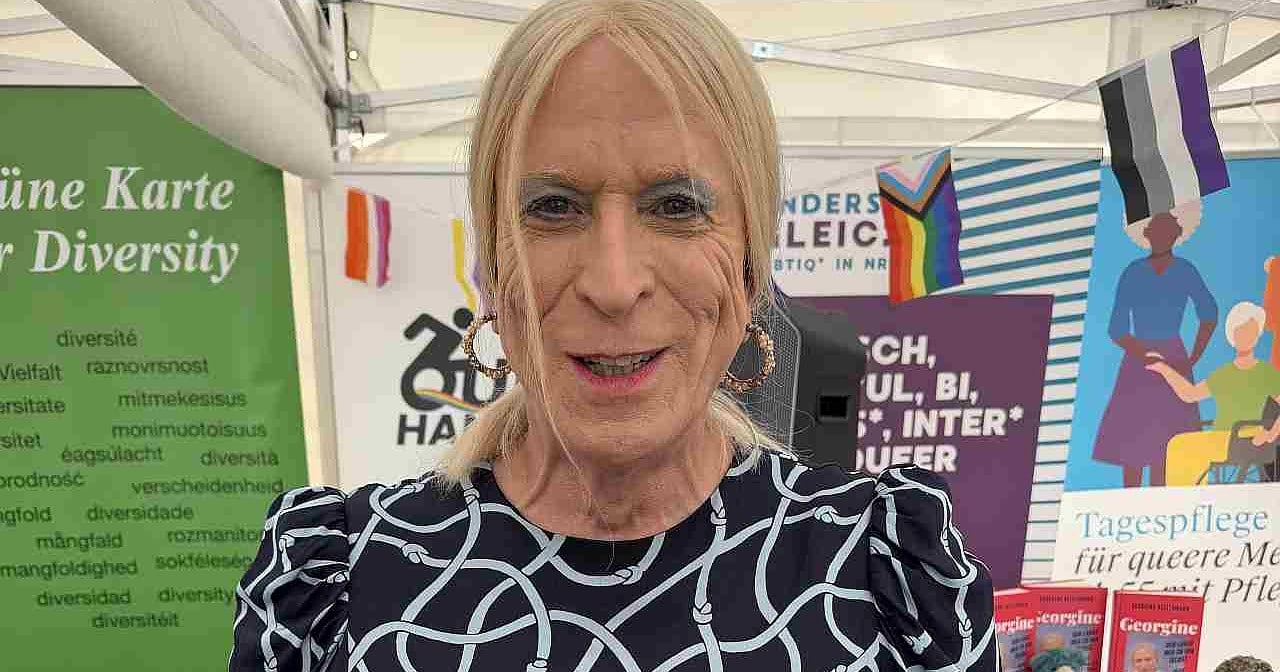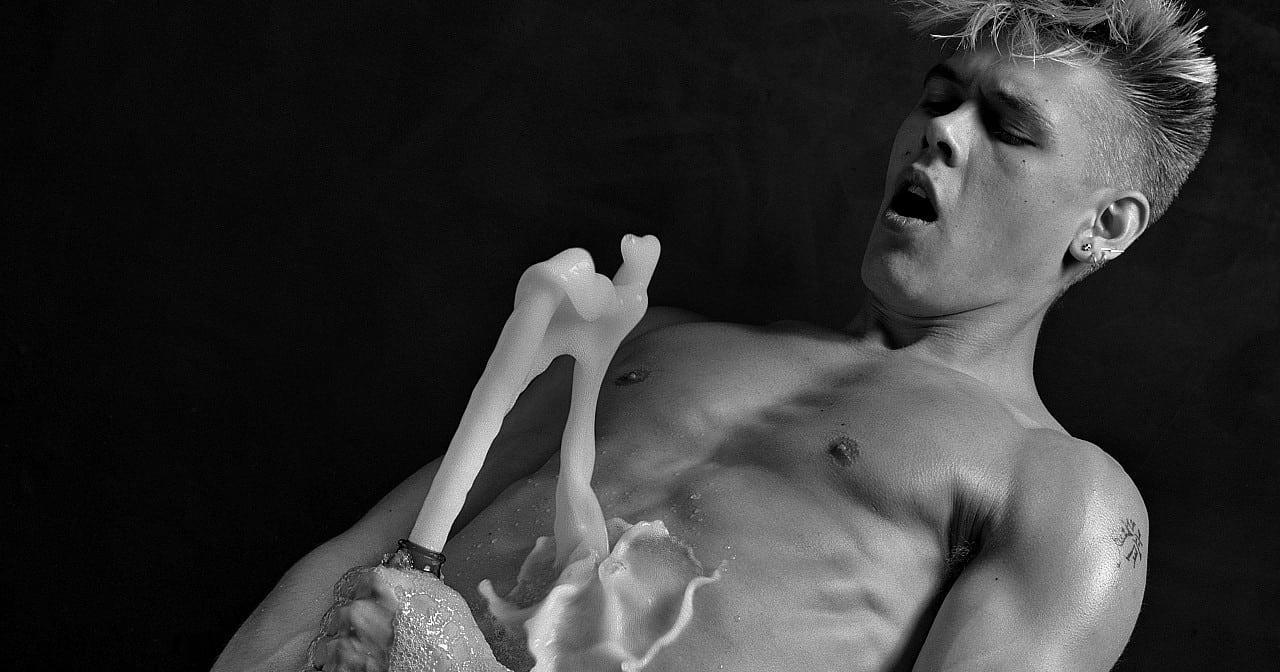
Who hasn’t seen this photo of the brazenly handsome naked young man, slightly arched backward, pressing a bottle against his groin as a jet of white, frothy champagne gushes forth? Dutch photographer Erwin Olaf conceived this image in 1985, and he gave it the title “Joy,” perhaps a deliberate understatement tucked into the frame. A champagne-brand advertising shot? Hardly—more like a sharp photographic punchline to something that French speakers might call “le petit mort.”
This photo and many others belong to a series Olaf named after the square format he used, “Squares.” What one could pack into these squares, given Olaf’s prodigious inventiveness, is often a marvelously bizarre sight. So too the photograph titled “Alandus”: a young man posed like a sculpture, with a thrusting groin and a back-bent torso, enveloped in a tight, striped fabric tube, as if the figure were literally growing from the ground like a floral ornament.
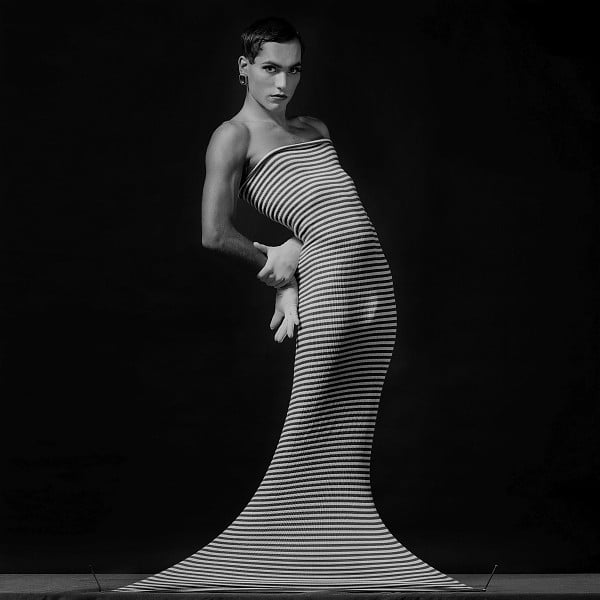
The indecipherable gaze of Alandus fixes us, the viewer, squarely in the eye. Sensuality can also be a riddle—a beautiful and, at the very least, a provocative puzzle.
Everything Revolves Around Beauty
The fact that the Berlin exhibition comes only now for the photographer Erwin Olaf, who was born in Hilversum in 1959 and who died far too young in 2023, is surprising. Munich’s Kunsthalle was indeed quicker and mounted a retrospective in 2021 under the motto “Uncannily Beautiful.” The double meaning of “uncanny” was intentional, and it remains present in the Berlin selection and palpable in Olaf’s ambivalence.
The Kreuzberg gallery f3 — free space for photography, in cooperation with the Erwin Olaf Foundation and with support from the Dutch Embassy, deserves thanks for helping to reveal essential facets of Olaf’s work.
In truth, it’s all about beauty—as seen even in subjects that conventional judgments would deem far from idealized beauty. For instance, depictions of older and heavier people, illness, and decay. And yet these meticulously staged photographs contain nothing accusatory. On the contrary. Sensuality knows no bounds, but it requires at least an audience with a correspondingly permissive sensibility.
Emancipated Queer Self-Image
Perfection, for Olaf, is rarely free from a jolt and is often linked with provocation. The seemingly smooth surfaces of these impeccably styled bodies reject the constraints of social norms in their queerness. That is precisely what underscores their incomparable beauty—the queerness itself and the pride it carries.
A particular weight in the Berlin show is given to the black-and-white portraits created in the Dutch queer community—a series Olaf titled “Muses.” His muses, like many portraits from the “Squares” series, symbolize an emancipated queer self-image. In this way Olaf became not only a pioneer of queer visibility, but his photographs are—if you will—manuals for self-celebration. And not least, they document the community as it wins social space.
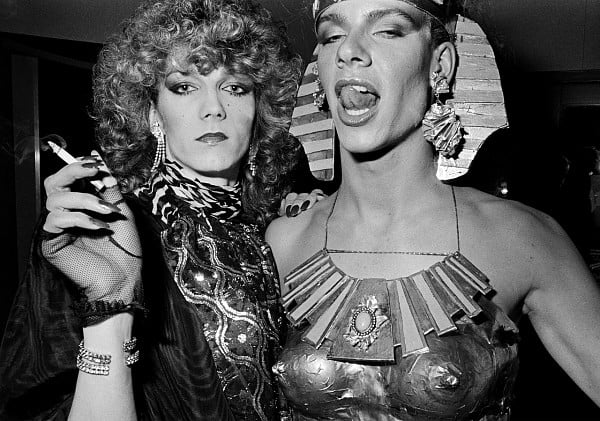
Lust, corporeality, sexuality — these were among Olaf’s favorite and most thoroughly explored fields of work, establishing him as a master of provocatively erotic, humorously surreal, and coolly detached stagings. The imagination seems inexhaustible, and the act of photographing itself reads like a sensual pleasure, perhaps the result of highly concentrated labor that left nothing to chance. That there is also political energy behind it goes almost without saying given the persistent, hostile climate toward queer people. The message: We are beautiful as we are—and no one will take that away.
The exhibition “Erwin Olaf — Muses” is on view through September 6, 2026.