Home » The Fifth Column » Recent Articles:

Weekend Preview Plus – 2/24/11 through 3/5/11

[by Mrs. Pederson February 24, 2011 Feature, Lifestyle, Nightlife, politics, The Fifth Column 1 Comment

Hello Muffins!

The week ahead is so jam packed I am exhausted even putting the Weekend Preview Plus together for you.  Whenever there is additional infomation available for any of the events I have included it is simple to find – click on the associated image!  More often than not it is a Facebook event page that you will be brought to.  No Facebook profile – what are you waiting for?  If you end up in a pickle without enough info to attend the event of choice feel free to email me at style@thecolu.mn

ENJOY!

THURSDAY

Saucy Salsa Lessons

Thursday, February 24 · 7:00pm – 8:00pm

3405 Chicago Ave, Minneapolis, MN

Queer and Trans friendly Salsa dance lessons
Every Thursday, 7-8pm
Starts February 24th, 2011

Taught by Jae Haile Phillips in our fabulous shared, queer space.

All ability levels welcome!

$10 a lesson OR
$50 for a 6 class series

Contact Jae Haile Phillips at Jae.phillips@hotmail.com or 612-709-8003 for more detailed information.

FRIDAY

SHAZAMORAMA

Friday, February 25 · 7:00pm – 11:00pm

Second Foundation School
1219 University Ave. SE

DISTRICT 202 & SECOND FOUNDATION SCHOOL present
A YOUTH DANCE PARTY: SUPERHERO THEME !!!
(FOR AGES 12-19)
*P.V.O.
$3/door
$2/in costume
$1/with pre-registration (info on that soon!)
A superfun, sober event with food, music, & amazing dancers (you)!
All GLBTQ youth & friends/allies welcome!
*Positive Vibe Only, please.

SATURDAY

Fitness Boot Camp

Saturday, February 26 · 10:30am – 12:30pm

“Out to change mindsets on exercise, Switch & Sweetpea offer group fitness ‘P4P BOOTCAMP!’ classes that mix and vary styles for cross-training, for fun, for life!’

In addition to basic cardio, strength-training, and flexibility foundations, you’ll experience everything from boxing drills and muay thai sequences to ballet, hip-hop, pilates, and burlesque combinations.

Classes are for all fitness levels. Wheather you are new to exercise, an advanced athlete, or coming back from an injury, you will get an incredible workout and have a great time doing it.

$10 suggested donation
(nobody turned away for inability to pay)

Brought to you by Rainbow Health Initiative and sponsored in part by The Minneapolis Park & Recreation Board.

FIERCE Love: Stories from Black Gay LIfe

Saturday, February 26 · 7:00pm – 10:00pm

Rarig Hall- The Thrust Theater
330 21st Avenue
Minneapolis, MN

“FIERCE LOVE: Stories from Black Gay Life” by the Pomo Afro Homos
Directed by Harry Waters Jr.
Location: The Thrust Theater in Rarig Hall at the University of Minnesota.
FOR ONE NIGHT ONLY
Feb. 26 2011 7:00pm. Admission: (CASH ONLY) $7 without a Student ID/present your student ID and pay what you can.

SOY New Year

Buasavahn Banquet Hall
7324 Lakeland Ave N
Brooklyn Park, MN  55428

$10.00 admission
$5.00 After Party Only

* Doors, open at 3 pm
* Program starts at 4 pm
* Pageant follows that and throughout the night
* Dinner at 6 pm
* Entertainment during dinner until 7:30
* Pageant continues until 9pm
* Open Mic and After party starts at 9 pm

Shades of Yellow (SOY) is a nonprofit Hmong LGBTQ organization that provides support, education, and advocacy to Hmong LGBTQ and allies. We are committed to creating a community that is aware of the issues that Hmong LGBTQ face. We are base out of the Twin Cities, MN. While we have capacity here, we are committed to providing support and education all across the nation if needed. Please do contact us if you and/or anyone you know need(s) our support.

SUNDAY

Loring Theater presents Mimosa Movies: “The Breakfast Club”

Sunday, February 27 · 2:00pm – 5:00pm

Loring Theater
1407 Nicollet Avenue S
Minneapolis, MN

HOLLYWOOD’S BIG NIGHT

Sunday, February 27 ·  6:00pm -  10:00pm

Kerasotes ShowPlace ICON
1625 West End Blvd.

Hosted by MyTalk (Jason Matheson and Alexis Thompson) & Twin Cities Live (John Hanson)

Benefiting Twin Cities Film Fest

$15 suggested donation to the Twin Cities Film Fest

RSVP at the following website to reserve your tickets:

http://mytalk1071.com/promotions/hollywoodbignight/

Receive the Red Carpet treatment on Sunday, February 27th as we celebrate the best movies of 2010! Dress up or come casual, either way you are in for a good time with myTalk 107.1′s Jason & Alexis and Twin Cities Live’s John Hanson. There will be appetizers, drink specials and great giveaways all night long!

MONDAY

Anoka Hennepin District Board Meeting:Fill the Room

Monday, February 28 ·  6:00pm -  8:00pm

The time is NOW! It is time that the Anoka Hennipen School District takes agressive action to ensure a safe and inclusive learning environment for LGBT students (and of course, ALL students).

Since last July parents, students, teachers and community members have requested the school remove the discrimantory sexual orientation curriculum policy. This policy forbid teachers from talking to students about issues, topics and concern…s about sexual orientation. They call it the “nuetrality” policy, but by definition it is not.

This policy is a major obstacle in addressing the causes of LGBT bullying and harrassment that has lead to at least four of the nine suicides in the last 18 months in this district. If you can’t talk about the homophobia that clearly exists in these schools, how do you get rid of it?

COME SHOW YOUR SUPPORT AT THE NEXT BOARD MEETING ON MONDAY THE 28TH. We want to fill the boardroom, so bring your friends, family and anyone that will come. Wear bright colors!

If you are concerned about transportation, please meet us at Metropolitan State’s Midway campus at 5:30. There will be a bus and people willing to carpool up to Coon Rapids and back.

Meeting information:
Time: 6:30pm
Address:
Anoka Hennepin District Office
11299 Hanson Blvd NW
Coon Rapids, MN 55433

WEDNESDAY

Txuj Ci Showcase “An evening of Hmong Queer and Allies talents”

Wednesday, March 2 ·  6:00pm -  9:00pm

U of M Twin Cities Coffman Union: The Whole Music Club

Come join us on March 2, 2011 for some amazing performances by artists such as Tou Saiko Lee, Artist Activist MR SOY 2010 Linda Hawj, Oskar Ly, Chong Moua, Pada Lo and more!!!!

*Free Food*
*Open to the public*
*Awesome Performances!*

For more information please contact us at:
glbta@umn.edu

THURSDAY and BEYOND

Fur Flee 2011 – FOUREVER!

Thursday, March 3 at 3:00pm -  March 6 at 2:00pm

Superior Wisconsin / Duluth Minnesota

RUN PASSES /FLEE COLLARS – $60.00
PURCHASE AT WWW.NCBEARS.COM
(you need a Run Pass to get into ALL hotel events and all drink specials)

http://www.ncbears.com/ncb/

Pounds 4 Pride – Winter Walk

Saturday, March 5 · 3:30pm – 6:30pm

Loring Park Community Center
1382 Willow St.
Minneapolis, MN

Celebrate The Final Days Of Winter

Come early for fitness boot camp. Mix and mingle with Pounds4Pride sponsors and spokespeople. Join in the lighted balloon parade at dusk.

Loring Park Community Center

3:30-4:30 Fitness Boot Camp
4:30-6:00 Meet & Greet Social
6:00 5K Luminary Winter Walk

The Winter Walk is brought to you by the Rainbow Health Initiative – Pounds4Pride Campaign

From the Archives: Molding a Generation, and Keeping Boys From Wearing Lacy Stockings

[by Stewart Van Cleve December 10, 2010 Feature, The Fifth Column Comments Off

The idea of queer place goes beyond simple physical geography, as a queer place can be a “place” in the past or a passage hidden within an old volume. Newspapers are, perhaps, the most readily-available sources of otherwise sporadic information that pertains to everyday queer phenomena. Regardless of the time period, headlines and back stories reveal constant battles between oppositiong genders and sexualities.

This essay is excerpted from Stewart Van Cleve’s upcoming book, Land of 10,000 Loves: Queer Places in Minnesota History, from the University of Minnesota Press – Ed.

At the dawn of the 20th century, Minnesota’s middle class was booming and anxious to scale the social ladder. In the Twin Cities, companies were particularly attuned to the populace’s constant quest for goods and services—especially for those products that suggested the buyer’s wealth and prestige. Local papers carried advertisements for everything from women’s products that made voluminous hair to men’s living quarters that guaranteed social respect. These ads often evince the underlying distress that many up-and-comers had over their attractiveness, success, and–of course–their particular brand of gender expression.

This consistent feeling of unease was not limited to adults. Early 20th-century parents subjected their children to expectations that mirrored those of older people. A supplement of the Minneapolis Journal (ancestor of the Star Tribune) called The Journal Junior was, literally, a smaller version of the “adult” paper. It carried entertaining tales (and ubiquitous comics) of boyish adventure and girlish imagination for decades, and likely helped to construct the local gender identities of an entire generation. Newspapers frequently assisted these businesses (for a price) and presented depictions of girls and boys to sell toys, games, and garments. “Little women” were expected to be precious angels with hopes of becoming married homemakers, while boys were drawn as briefly mischievous future heads of household.

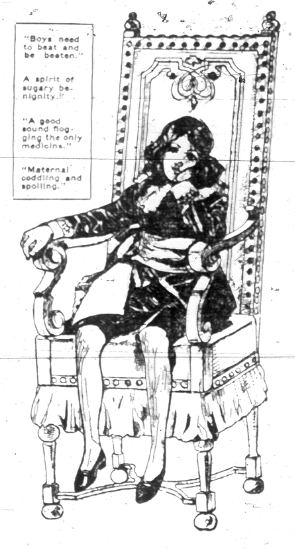
On Tuesday, February 18, 1908, The Minneapolis Journal took out a full-page ad for its subsequent Sunday Magazine. Depicting a cartoon boy with long hair, lacy stockings, and bad posture (looking remarkable like a miniature Oscar Wilde), it proclaimed “Feminzation of Boys is a subject handled without gloves by G. Stanley Hall, President of Clark University.”

The ad continued: “There is something the matter with the boy in the early teens who can truly be called a perfect gentleman, as his lady teachers wish him to be,’ declares Dr. Hall, whose articles on childhood’s problems have won him a national reputation. The article will appear exclusively in next Sunday’s Magazine of the Minneapolis Journal.”[i] The Journal’s notice gives a taste of Hall’s ideas concerning the problem; snippets surrounding the effete boy suggest that “a spirit of sugary benignity” results from “maternal coddling and spoiling.” Women were to blame, but all was not lost. Hall declared that “boys need to beat and be beaten,” and that “a good sound flogging is the only medicine.” The ad ended with the promise of argument: “A number of well known women have written replies to Dr. Hall for the succeeding issue.”

Unfortunately, and with an understandable need to conserve space, the Minnesota Historical Society transferred its vast newspaper collections to a problematic format—microfilm—and scanned every page onto the new media. The tedium of this process produced many mistakes, including a numerical error that accidentally omitted Dr. Hall’s article (not to mention dozens of issues of The Sunday Magazine). As no original master set was preserved, Hall’s recommendation (and alas, the replies of “well-known women”) were irreversibly destroyed. Historians will never know the full extent to which Hall’s theories were accepted or rejected by local mothers, but the article’s preserved advertisement is worthy of immense historic value on its own. Rarely can one find a literal advertisement for gender, let alone one that advertises a means of “fixing” nonconformity.


[i] The Minneapolis Journal, Home Edition, 2/18/1908, page 6.

From the Archives: Chocolate Dandies, Vice Cities

[by Stewart Van Cleve November 8, 2010 Feature, The Fifth Column Comments Off

Noble Sissle and Eubie Blake, two Broadway performers who visited in Minneapolis in 1924

Considered by some to be America’s “golden age,” the Art Deco era of the 1920′s and 1930′s has been romanticized ever since the Great Depression as a time of relaxed social restriction.[i] It was a time of “New American Women,” a period when African Americans migrated to northern cities from the south, and an explosion of new cultural expression.  The  latter two phenomena created an often-overlooked and occasionally-ignored facet of the “Harlem Renaissance.”  In many U.S. cities, large African American districts—then referred to as “negro areas”—supported smaller queer cultural circles.  Most notably in Harlem, these undergrounds centered on “rent parties,” drag balls, and particular entertainment venues.[ii] Gladys Bentley sang dirty songs (with a sophisticated voice) in a white tuxedo at the Clam House,[iii] while Langston Hughes and Richard Bruce Nugent partied with other “gay” (in the sense that they had sexual relationships with other of the same gender) literary greats in private apartments.[iv] While Minneapolis was a little too far upriver to enjoy the same kind of cultural output of New York City or Chicago, and the associated “out” LGBTQ communities there, among the scraps of evidence left by local Jazz Age partiers, we’re left with a few hints of the “gays” that might have been.

That is not to suggest that the Twin Cities were completely bereft of black folks or queer undergrounds, but the evidence is scant.  Roy Wilkins, future president of the NAACP, grew up in St. Paul’s Rondo neighborhood – at the time, the capital’s most integrated neighborhood and arguably one of its most culturally vibrant.  While Wilkins was a youth, the neighborhood was home to numerous “good time parties,” which were Minnesota’s nearly-identical answer to more famous rent parties out east.[v] Little information, and certainly no known written accounts, attest to the existence of a queer subculture in old Rondo’s party scene.  Minneapolis’ northside also supported a larger black neighborhood near Sumner Field on the North Side, but scholars again run into a similar dearth of information about LGBTQ life in this neighborhood.

I found one clue in old issues of the Minneapolis Journal. In January of 1924, Noble Sissle and Eubie Blake brought their Broadway show, titled “Chocolate Dandies,” to the Metropolitan Theater in the Gateway District (located at 320 Marquette, if you’re a geography nerd like me). Among the show’s dancers was none other than Josephine Baker, who challenged gender roles and had numerous affairs with other women during the 20s.  The show was well-received locally by an entirely white audience,[vi] but some critics believed that it presented white stereotypes of black people to entertain white audiences.[vii]

Another piece of the puzzle sits within an old book at Hennepin Central Library.  In 1937, years after the Stock Market Crash, Calvin F. Scmid wrote an impressive sociological analysis of the Twin Cities area.  The project, funded by the Works Progress Administration, used an entire chapter to describe the “negro areas” of St. Paul and Minneapolis.  The study interestingly framed these areas as part of a greater series of “Vice areas;”[viii] Schmid noted that black citizens were socially forced to live in “marginal areas of the city, in which vice, crime, disease, bad housing, dependency, and other forms personal and social disorganizations are prevalent.”[ix] Other vice districts included the Gateway District, Loring Park, and the “Seven Corners” created by Washington Avenue and Cedar Avenue—each of these vice areas had a queer future ahead of them.

Great steps have been taken to note the significance of LGBTQ people of color in queer history, but our society still runs the terrible risk of losing a century’s work of queer life experiences, if only because so little has been recorded about the experiences of people of color.  Queen Latifa may have sang a single number in Chicago as Matron Mama Morton, but few can identify her character as a reference to (a definitely lesbian) Ma Rainey.[x] Likewise, we can draft a comparison between Harlem’s rent parties and Rondo’s good time parties, but without personal accounts, this remains a conjecture.

If you know a longtime local resident who is LGBTQA and lived near Rondo Avenue or on Minneapolis’ northside during the 1930s-1960s, please contact me at vanc0092@umn.edu.  I would love to include their stories in my upcoming book.


[i] Lawrence R. Broer and John D. Walther, editors. Dancing Fools and Weary Blues: The Great Escape of the Twenties (Bowling Green, OH: Bowling Green University Press, 1990)

[ii] Shane Vogel, The Scene of Harlem Cabaret: Race, Sexuality, Performance (Chicago: University of Chicago Press, 2009), 18-25

[iii] James F. Wilson, Bulldaggers, Pansies, and Chocolate Babies: Performance, Race, and Sexuality in the Harlem Renaissance (Ann Arbor, MI: The University of Michigan Press, 2010), 174

[iv] Wilson, 27

[v] Evelyn Fairbanks. Days of Rondo: A Warm Reminiscence of St. Paul’s Thriving Black Community in the 1930s and 1940s, (St. Paul: Minnesota Historical Society Press, 1990) page 153.

[vi] “Sissle and Blake at Metropolitan: ‘The Chocolate Dandies’ Latest of the Colored Musical Shows,” The Minneapolis Journal, February 23, 1924.

[vii] Nadine George-Graves, “The Chocolate Dandies,” Encyclopedia of the Harlem Renaissance (New York: Routledge, 2004), 223-224

[viii] Calvin F. Schmid, Social Saga of Two cities: An Ecological and Statistical Study of Social Trends in Minneapolis and St. Paul (Minneapolis: The Minneapolis Council of Social Agencies, 1936) Chart 195

[ix] Calvin F. Schmid.  “Your Minneapolis: An Abstract of Social Saga of the Two Cities” (Minneapolis: Minneapolis council of Social Agencies, 1938), 41

[x] Of course, this is a suggestion.  Take a close look at Latifa’s costume and bawdy performance, and then take a look at photos of Rainey in action.  The similarity is unmistakable.

From the Archives: Looking For Gays in the Gateway District, Part 2

[by Stewart Van Cleve October 13, 2010 Feature, Lifestyle, The Fifth Column 1 Comment

James Flood after his arrest. He had shaved his head in order to wear a wig. (© Minnesota Historical Society. Photo used with permission)

A Minneapolis patrolman immediately took James Flood into custody—in full drag—after Flood shot and killed A.P. Camden on Nicollet Avenue in the dead of night. As part of the booking process, the officers measured more than a dozen parts of his body and noted the measurements in a “Bertillon Book.” These ledgers recorded body measurements for identification, and accompanied the first use of mug shots in the late 19th century,[i] offering a firsthand account of criminal activity in the Gateway District during one of the most volatile periods in the city’s history. 

Murder is murder, of course—regardless of the time period, Flood was arrested because he killed someone.  However, it is entirely possible that Flood’s flagrant challenge to gender norms influenced his treatment by the police, and equally influenced his confessions, conviction and incarceration.   Six years before Flood’s arrest, a federal grand jury sentenced Mayor A. A. ‘Doc” Ames to six years in state prison for running one of the most corrupt administrations in the United States. The disgraced politician instituted a number of surreptitious practices, but he is perhaps best known for his permissive (some would call tolerant) treatment of prostitution, gambling, and liquor in the old Gateway area.[ii] Mayor Ames’ arrest marked a clear change in the police department’s arresting criteria, and likely inspired a crackdown on prostitution and other kinds of “abnormal” sexual behavior in Minneapolis.

Flood’s arresting officer pasted a small clipping from The Chicago Tribune next to his entry in the 1908 Minneapolis Bertillon Book, which gives additional details of that night in June:

“A.P. Camden, an elevator builder and for fifteen years a resident of St. Paul, was shot and instantly killed late last night in front of the store at 315 Nicollet avenue, by James Montague, 16 years old.

Camden was a total stranger to Montague.

As the man passed the boy he [Montague] took the revolver from his pocket and without reason of provocation, shot Camden in the head, and the victim fell dead at his feet.  The murderer then walked away whistling, but was followed by messenger boys who had witnessed the tragedy and was captured at Nicollet and Washington avenues by Patrolman R. E. Champlin.

At the time of the shooting, the boy wore some articles of woman’s apparel.  His story today in the sweatbox  was a fantastic tale of boyish adventure and depravity.  This story, which the police believe is true only in part, is being checked up carefully by detectives.  The prisoner is clearly insane.”[iii]

The Tribune’s report illuminates two questionable aspects of testaments to Flood’s “insanity.” The first—that Camden and Flood were “total strangers,” (thus Camden’s murder was completely unprompted) is hard to accept as indisputable fact.  The police originally suggested that the two were strangers in their report, yet the police only became involved with the case after Camden was dead.  No one is quoted, either by the police or by the Tribune, as saying that the two had never met before.

Second, the paper notes that Montague told his “fantastic” (and perhaps incoherent or crazy) tale of “boyish adventure and depravity” durring interrogation “in the sweatbox,” an interrogation procedure where suspects were put in a small room with several officers, and subjected to hours of verbal abuse and misleading questions.  In a 1902 article, The Public, a Chicago newspaper, censured the practice of sweatboxes, claiming:

“Ordinarily the torture—for it is nothing more—is especially designed for the case under consideration.  It the police are satisfied that that any person possesses information which may reveal the principles or participants in a great crime, they will get it and they feel justified employing any means, no matter how severe and cruel, and it will result in a confession.”[iv]

Flood’s unspecified confession of “depravity” could have involved anything the officers wanted or suspected—indeed, the police questioned whether or not the teenager was being completely honest. It is interesting to also note that officer Champlin mentioned Flood’s wig and style of dress as an afterthought.  The Chicago Tribune, on the other hand, excitedly proclaimed Flood “Existed as a Boy but Slew as a Girl!” before it surmised that he was “possessed of a dual personality, with each element battling for supremacy…”[v]

Ultimately, the court accepted his admission; he was sentenced to spend his life in the Minnesota State Reformatory in St. Cloud.[vi]

Next Time: People of Color In and Out of the Gateway


[i] Hess, Kären M., Orthmann, Christine Hess.  Criminal Investigation, 9th edition. New York: Delmar, 2010. Page 53.

[ii] Minneapolis Vice Commission, Report of the Vice Commission of Minneapolis to His Honor, James C. Hayes, Mayor.”  Minneapolis: Henry M. Hall Press, 1911..  Written almost a decade after Ames arrest, this lengthy report analyzed the “recent” history of prostitution in Minneapolis.  It also weighed the pros and cons of legalizing, tolerating, and criminalizing prostitution—the report even suggested establishing a single red light district on Nicollet Island.  In the end, the Commission recommended criminalization.

[iii] “Camden Had Premonition.” The Chicago Tribune, June 4, 1908.

[iv] The Public (bound edition). Originally printed March 29, 1902.

[v] “Existed as a Boy but Slew as a Girl: Woman Personality Drove Youth to Kill A. P. Camden in Minneapolis.” The Chicago Tribune, June 5, 1908.

[vi] Minneapolis Department of Police. Bertillon System Record No.1: From Jan. 4, 1907 to Dec. 19, 1907.  Minneapolis: Cerber Bros, 1906.  Record no. 382, June 3, 1908

From the Archives: Looking for Gays in The Gateway District

[by Stewart Van Cleve September 28, 2010 Feature, The Fifth Column 2 Comments

James Flood after his arrest. He had shaved his head in order to wear a wig. (© Minnesota Historical Society. Photo used with permission)

Little of downtown Minneapolis belies the city’s 19th-century beginnings.  The City of Lakes constantly reacts to changes in popular trends, adopts the latest fashions, and makes every effort to obscure signs of old age.  Nowhere is this practice more evident than in the city’s Gateway District.  For decades, “The Gateway” was Minneapolis’ go-to area for prostitution, vagrancy, and yes, surreptitious queer behavior. The area’s flagrant disregard of Postwar norms eventually brought about its destruction; in the early 1960s, the City of Minneapolis used Federal money to completely demolish the area, which comprised 40 percent of downtown Minneapolis.  A few of the neighborhood’s survivors—such as the Brass Rail and the Gay 90s—remind us of LGBT life in early-to-mid 20th century America.

My study of the Gateway began with a single passage in a sizable book.  In Lost Twin Cities, Larry Millet wrote extensively of the Gateway’s architectural grandeur. Millet noted that, for almost a century, Minnesota businessmen built stately offices, lavish hotels, and grand public buildings near the intersection of Washington, Nicollet, and Hennepin Avenues to impress investors with the power of the Midwest’s industrial production and its commercial prestige.  Following decades of decline, Minneapolis’ oldest neighborhood came to be a civic embarrassment—Millet summed up its eventual population with  two sentences. “Not all of its drinking establishments were rotgut dives, and some—such as the Persian Palms nightclub—attracted a middle-class clientele searching, often with considerable success, for a taste of sin.” He wrote.  ”The area also featured bars that catered to blacks, gays, and others not welcome in mainstream Minneapolis.” (1)

Surely, I thought, there’s more to the story of “gays” in the Gateway than a passing mention.  How did the Gateway come to attract a queer underground?  What Gateway bars catered to queer people? What bars catered to people of color? Why are these two groups assumed to be historically separate?

I set about finding answers to these difficult and began with the Tretter Collection in GLBT studies—where all local quests for LGBT history should begin.  The Tretter Collection had a relatively small amount of information—I discovered that, sadly, queer Minneapolitans did not actively produce many written accounts of their experiences during this era.  As a result, the Tretter Collection has little source material to preserve.

The sidewalk where Flood shot his victim (© Minnesota Historical Society. Used with permission)

Luckily, there are many other resources at the disposal of local historians.  I contacted the City of Minneapolis’ records management office in February of 2009 and explained my quandary. The office’s staff helpfully recommended a few sources within their collection.  Located below the clocktower in City Hall, the Municipal Archive is itself a piece of history.  Modeled after other late 19th century libraries, the (often-forgotten) space contains four levels of oak shelving, wrought-iron railings, stone floors, hundreds of brittle volumes, no heat source, and (to my shock) a sole electrical outlet.

After reading hundreds of run-of-the-mill criminal reports from the Minneapolis Police Department, I ran across an entry that suggested queer goings-on were part of the Gateway for most of the 19th century.  In the summer of 1908, police responded to a gunshot on Nicollet Avenue and 3rd Street (the present-day location of Central Library).  James Montague, a 16 year-old youth donned head-to-toe in women’s clothing (complete with shaved head and wig!), walked up to a middle-aged man and shot him in the head. (2)  The Chicago Tribune reported that Montague’s victim, an elevator builder named A.P. Chandler, had a “premonition” about his death, yet the paper claimed that Chandler was unacquainted with Montague before being shot. (3)  Police took Montague into custody, and reported that the young man was “clearly insane.”  Jackpot.

To be continued…

(1) Millet, Larry. Lost Twin Cities. St Paul: Minnesota Historical Society Press, 1992.  Page 267.

(2) Minneapolis Police Department. “Bertillon Ledger: 1917.”  Record No. 382.

(3) “Camden Had Premonition.” The Chicago Tribune, June 4, 1908.


From The Editor’s Desk: Lavender Gets it Wrong on HIV disclosure

[by James Sanna April 27, 2010 Feature, Health, Rants, The Fifth Column 3 Comments

In its last issue, Lavender magazine ran a “public service announcement” about Daniel James Rick, a Minneapolis man that police say has had unprotected sex with other men without disclosing that he is HIV-positive. TheColu.mn feels that Minnesota’s largest LGBT publication not only missed an important opportunity to provide context to the case but also furthered the stigmatization of HIV-positive Minnesotans.

Lavenderuncritically printed its article as a “public service announcement” at the request of the Minneapolis Police Department without context. It doesn’t discuss scientific research that, according to Keith Horvath, an HIV prevention expert at the University of Minnesota’s School of Public Health, shows that only around 5 percent of HIV-positive men in America pass that disease on to a sexual partner every year. The police’s case against Rick — which still has to be proven in a court of law — is a rarity among HIV-positive men.

If the charges against Rick are true, then he would certainly have done a selfish, negligent, and generally reprehensible thing in knowingly transmitting a disease to someone else. However, when the laws governing the transmission of HIV were enacted in the early-1990s, the world of HIV was a different place. Today, a 35-year-old HIV-positive American man with the aid of medical treatment can be expected to live to age 73 on average, according to Horvath.

According to police and Lavender, Rick is charged with “Assault in the Third Degree—Knowing Transfer of Communicable Disease.”

The effectiveness and feasibility of such laws are surely up for debate and you can read the statute for yourself.

The World Health Organization, supported by a growing body of academic research, has came out in 2006 against laws that criminalize HIV, saying that such laws stigmatize those living with HIV and discourage people from getting tested for the virus. The vast majority of people who test positive for HIV take steps to ensure the virus isn’t passed on to other. And criminalizing the transmission of HIV will also create an atmosphere of fear where people may avoid getting tested.

Furthermore, the Lavender’s story fails to mention that, in each case where Rick has been charged, there was at least one receptive partner who did not demand that Rick use a condom. In at least one case, according to court documents (PDF), the alleged victim was drunk at the time of the encounter and was removed from the Saloon by staff because he was overly intoxicated.

“No” always means “no” is not enough when sex is concerned. People have to have the ability to say “Yes,” and the allegations against Rick are serious if proven true beyond a reasonable doubt. But we also know from years of research that intoxication with drugs and alcohol are implicated in new HIV infections among gay men with some studies reporting the incidence as high as 60 percent.

Whether intentionally, or because they weren’t aware of the facts and issues surrounding the transmission of HIV, the publishers and editors of Lavender ran a story that misrepresented HIV-positive gay and bisexual men as predators to be avoided, not the largely responsible friends and brothers they are. In doing so, they not only stigmatized members of the Minnesota LGBT community who they theoretically serve and missed an opportunity to challenge the growing acceptance of risky sex practices in our community, but they hurt the rest of us by spreading attitudes that directly harm HIV prevention and safe sex education efforts statewide.

The facts are that HIV can be avoided by using condoms correctly and consistently, and they are especially important with partners you don’t know.

Lavender’s editor did not respond to my call asking for more information about why they decided to publish this story, but as the largest LGBT publication in Minnesota, I hope they made an informed decision with the best interests of the community at heart, even if the available evidence suggests otherwise.

TheColu.mn Is Going For Gold to Help Greater MN Fight Homophobia

[by James Sanna February 2, 2010 Feature, The Fifth Column Comments Off

As many of you know, TheColu.mn is in the running for a $25,000 Pepsi Refresh grant that would let us build a network of LGBT community journalists throughout Greater Minnesota.

The “Not the Only One” project provides lesbian, gay, bisexual and transgender Minnesotans living in non-urban areas the opportunity to share their lives with readers across the state and to confront homophobia in their communities. The project will recruit and train 15 community members from small towns and tribal reservations throughout the state in journalism, community organizing and new media in order to promote tolerance, confront homophobia and create safe spaces for members of the community in often hostile environments, and help the writers build a local LGBT blogs to bring community together and serve as clearinghouses of information. At the end of the year, we will publish 500 books showcasing these writers’ best work, to be distributed at Pride events throughout the state in the summer of 2011.

Here’s where you, our readers, come in: Pepsi will be giving out 10 grants in the $25,000 category, based on which of the 188 proposals in our category receive the most votes over the course of February. We need your votes. You’ve seen the great reporting we do, even on a shoestring budget and after only a few months of existence. You’ve seen us cover the Sexual Violence Center, same-sex marriage protests of all kinds, December’s hate crime in Northeast Minneapolis, LGBT rights in the race for governor, and the dramatic rise in rates of new HIV cases long before the Star-Tribune ever thought about the issue. You know we will bring the same passion and teach the same skills to the citizen journalists we recruit as part of “Not The Only One.”

You can vote only once a day, for your 10 favorite ideas, but you can still vote every day of the month until this month’s contest closes at midnight on February 28th. You will have to create an account with Pepsi’s refresheverything.com website, but we are told Pepsi will not share your email – it is simply to make sure you are only voting for a project you support one time per day. Or you can use Facebook Connect which simply uses your Facebook account to verify your identity.

So sign up at refresheverything.com, and look for our project in the $25,000 grant category. We need your vote today, tomorrow, and every day in February to make this wonderful project a reality. We’ll thank you, and so will your fellow LGBT Minnesotans.

Yours,

The Editors: James, Andy, and Keith

Plugin from the creators of Brindes :: More at Plulz Wordpress Plugins